⟵ 02 The Hero of Heat Transfer · Contents · 02 The Hero of Heat Transfer (Engineering Notes) ⟶
The Hero of Heat Transfer: Narrative
The Experience of Heat Transfer
My old swim coach liked to keep the pool cold. He swore it made us swim faster, and he was absolutely right. I can still feel it – standing on the blocks first thing in the morning, staring down at the water, dreading the dive.
The pool was 72°F.
You keep your house at that same 72°F and never think about it. Same number. Completely different animal. The room is comfortable enough not to notice. The water feels like ice.
The difference is not a trick of perception.
It is the physical reality of heat transfer.
The pool is not actually colder than the room. It is simply better at taking heat from you – relentlessly, instantly, the moment you break the surface. That difference comes down to one thing: contact. Air barely touches you at all.
Air is a poor conductor. Its molecules are widely spaced and weakly interacting, making it difficult for molecular motion to pass from your skin into the surrounding atmosphere. You lose heat slowly, and the loss is comfortable.
Water is different. Water is a coupler. It conforms to the microscopic contours of your skin and maintains intimate contact across the surface. That contact is what allows heat to pass freely and continuously between you and the water. When you step into the pool, the shock you feel is not cold – it is energy. Your body heat is being pulled from you, molecule by molecule, because water is in persistent, unbroken contact with your skin.
This is conduction. You are feeling it.
As you move through the water, you feel something else. Fresh, cold water sweeps past your skin, carrying away the heat you just surrendered, and replacing it with more cool water. The motion of the water is carrying energy with it.
This is convection, enabling further conduction. You are feeling that too.
Now as you step out of the pool and reach for a towel, you feel a chill that has nothing to do with the surrounding air. You’re standing still. Nothing is rushing past you. The air temperature hasn’t changed. And yet you feel colder than you did in the water.
This is latent heat, and you are feeling it through evaporative cooling: the energetic cost of water leaving your skin. As each droplet evaporates, it steals the energy required to escape from whatever it was touching – which, in this case, is you. The cooling sensation is not the presence of water. It is the cost of its departure.
Three mechanisms. Three sensations. All happening on your skin, all felt within seconds of one another.
In each moment, what you are feeling is heat transfer.
Now multiply them.
The same conduction that pulls heat from your skin in a swimming pool is pulling heat from a condenser tube in a cooling system, a thousand gallons per minute, twenty-four hours a day.
The same convection that carries energy past your body as you move is carrying megawatts of thermal load through miles of chilled-water piping in every hospital, data center, and office tower in the world.
The same evaporation that cools your skin as you reach for a towel is cooling an entire building’s chiller loop by rejecting its heat to the atmosphere, one droplet at a time.
Your body feels these mechanisms because water is touching your skin.
Modern civilization depends on them because water is touching everything else.
Managing Heat
The modern world depends on heat transfer.
It happens so effectively that it is almost entirely invisible. Heat is delivered where it’s needed, removed where it causes problems, and redistributed continuously to keep systems stable. From power generation and manufacturing to food safety and climate control, nearly every system we depend on relies on one fundamental capability: the controlled movement of thermal energy.
For some systems, heat is the goal. Steam turns turbines. Reactor vessels hold temperature. Products are cured, sterilized, or transformed. With enough fuel, heating things up is relatively easy.
For other systems, heat just happens. It is the unavoidable byproduct of work - friction, electrical resistance, compression, metabolism, and entropy asserting themselves. Data centers, motors, compressors, electronics, and humans simply generate heat.
Left unchecked, heat is relentless and destructive. It warps metal, accelerates corrosion, destroys lubricants, weakens polymers, and shortens the life of everything it touches. Too much heat, in the wrong place, for too long, and systems begin to fail.
The challenge is that heat is a deeply inconvenient thing to work with.
It has no mass, no shape, and no container of its own. Heat is simply molecular motion - the collective vibration, rotation, and translation of particles within a substance. When heat moves, nothing visible travels with it. Only energy changes hands.
Heat Only Moves One Way
You can’t just add “cold” to make heat less hot. Heat moves in one direction only: Hot → Cold.
Just like the frigid pool, heat has to be absorbed into something else. To pull heat out of a process, you have to give the energy somewhere to go – a continuous path leading away.
There are only a few ways to build that path.
Radiation: Energy emitted as electromagnetic waves across empty space. It requires no contact and no medium, but typically plays a negligible role in industrial water systems.
Conduction: Energy passed directly from molecule to molecule through physical contact. The hotter, faster moving molecules transfer energy to cooler, slower moving ones.
Convection: Energy carried along as matter itself moves from one place to another. Hot fluid rises away from a heating surface, physically carrying energy from higher-temperature regions to lower-temperature ones.
In most industrial systems, heat transfer is accomplished almost entirely through conduction and convection - both of which are brutally sensitive to how well molecules stay connected.
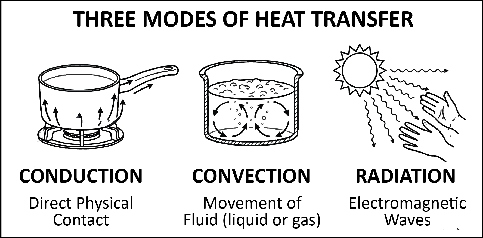
Conduction demands proximity. For energy to pass from one molecule to the next, the fluid must stay close enough to the surface to interact, again and again. Gaps, voids, and weak interactions interrupt the flow. When contact breaks, heat transfer stalls.
Convection demands coherence. The medium must move as a connected whole, carrying energy with it rather than shedding it along the way. If coherence fails, the energy disperses and bleeds back into the system.
Most substances falter at one of these. You already felt the difference in the pool – air’s widely spaced molecules can neither conduct nor convect efficiently. Other liquids do better. Most still fall short.
This connection is what gets put to work in every industrial system. At a heat exchanger, a thin metal barrier passes energy between two fluids without letting them mix. Metal’s freely moving electrons make it an excellent conductor: the hot process fluid hits one side, energy conducts through the metal, and the coolant absorbs it on the other. The entire transaction depends on the coolant staying in continuous, coherent contact with that surface - proximity and coherence, working at once.
Many fluids can move heat if you force them to flow. Few can hold contact and carry the energy away at once. Heat leaks away. Temperature gradients form. Hot spots develop.
This is where water stands apart.
Adhesion, Cohesion, & Heat Transfer
Water isn’t just good at transferring heat. Water is built different.
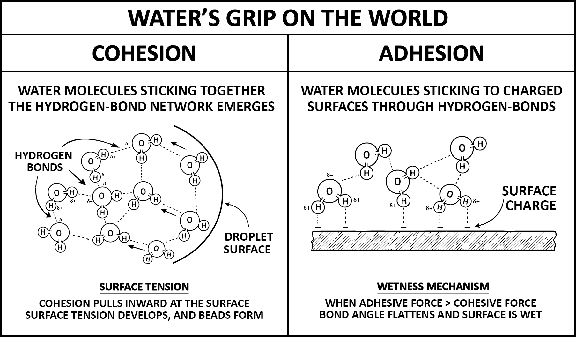
Its unique geometry creates a permanent charge distribution across its polar molecules. This allows water to form hydrogen bonds - persistent, directional intermolecular attractions with neighboring molecules.
Those bonds produce two defining behaviors: water clings to other things (adhesion), and water clings to itself (cohesion).
Adhesion is the attraction of water molecules to other substances.
The slightly positive hydrogen ends and slightly negative oxygen ends of a water molecule are attracted to charged or polar groups on surfaces. This allows water molecules to spread across heat exchanger tubes, and keeps them close enough for energy to be exchanged through conduction.
Cohesion is the attraction of water molecules to one another.
Because the individual hydrogen bonds are weak and fleeting, water stays low in viscosity – it pours and flows freely. Yet collectively, those same bonds pull the molecules into a constantly shifting embrace, holding the bulk fluid together so it moves as a coherent whole. That combination is what enables efficient convection: energy carried away from the surface through water’s own movement.
| CONCEPT LOCK Adhesion connects water to surfaces. Cohesion connects water to itself. They allow water to absorb energy through conduction and transport it through convection. |
|---|
Together, these two forces enable an exceptional capacity for water to absorb heat.
But they also define its limit.
The Hydrogen-Bond Network acts as internal scaffolding, working to keep molecules together while added heat works to pull them apart. This negotiation between intermolecular cohesion and molecular motion ultimately decides what state water is allowed to be in.
Water’s ability to transfer heat is remarkable.
Its ability to absorb and transform it is truly astonishing.
A Matter of State
Every drop of water exists in a state of negotiation. Its phase - solid, liquid, or gas - is determined by the balance of two competing forces:
Intermolecular Cohesion (Bond Energy): This is the electrostatic attraction pulling molecules together. It is governed by charge disparity and appears in several strengths. London dispersion forces are weak and fleeting. Dipole-dipole interactions are stronger. Hydrogen bonding is the strongest of these interactions and, in water, gives rise to the Hydrogen-Bond Network.
Molecular Motion (Kinetic Energy): This is the energy pushing water molecules apart. It is governed by thermal energy and expressed through several modes of movement: translation, rotation, and vibration. Temperature measures the average kinetic energy of all particles combined – some move faster and others slower.
Add heat and molecules move faster, overpowering cohesion. Remove heat and molecules slow down, allowing cohesion to take over. The phase of water is simply the outcome of that contest.
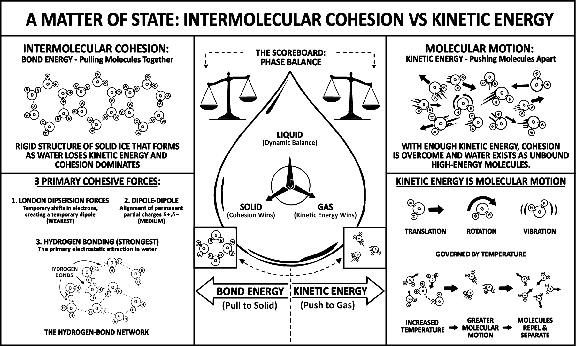
Solids form when cohesion dominates.
Molecular motion is restricted primarily to vibration, resulting in a defined shape and volume. In ice, the ordered arrangement of the Hydrogen-Bond Network spreads molecules slightly farther apart. This explains why ice floats, why pipes burst, and why snowflakes form with six-pointed symmetry – each one a frozen record of water’s molecular structure.
Liquids form when molecular motion and cohesion are roughly matched.
In water, hydrogen bonds are broken and reformed continuously, allowing molecules to slide past one another while remaining tightly connected. This gives liquids a fixed volume but allows them to conform to the shape of their container. (This observation has been used to argue, with some justification, that cats behave like liquids when presented with an appropriate box.)
Gases form when molecular motion overwhelms cohesion.
Steam consists of water molecules moving independently through space, unbound by the Hydrogen-Bond Network. Without cohesion, water vapor expands to roughly seventeen hundred times the volume of the same mass of liquid water. This expansion explains why balloons inflate, and why an errant fart seemingly races across the room.
State Transitions
Nothing about this framework is unique to water. Every substance occupies a state defined by its unique balance of molecular motion and intermolecular cohesion. However, driving a substance from one state to another requires energy.
For a liquid to transform into a gas, three conditions must be met:
1. Sensible Heat (Building the Speed)
The substance must be heated to the point where molecular motion can challenge cohesion. This added energy increases translation, rotation, and vibration, spreading molecules farther apart. Because this energy changes temperature, it is known as sensible heat transfer (it can be sensed or measured by a thermometer).
2. Latent Heat (Breaking the Bonds)
Motion alone is not enough for phase change. To fully convert into a gas, molecules must be separated far enough apart for cohesion to fail completely. The energy required to accomplish this final arrangement is the latent heat of vaporization. This added energy no longer raises temperature, but is spent overcoming intermolecular attraction between molecules.
3. Pressure (The External Weight)
The first two conditions are the molecule’s own struggle: build speed, then break bonds. Pressure is different. It isn’t a step the molecule takes – it’s the external weight pressing down on the whole negotiation, setting the price of every step.
Here’s why it matters. When a molecule escapes into vapor, it doesn’t just break its hydrogen bonds – it expands, violently, into vastly more space than it occupied as a liquid. To make that room, it has to push back everything sitting above the surface: the atmosphere, the steam, whatever weight the system is holding. The heavier that load, the harder the molecule has to push to break free.
Pressure does not change how much energy the molecules have. It changes how much they need.
High pressure – from pumps, compressors, or confined steam systems – forces molecules to reach higher temperatures before they can fight their way out. Low pressure – from vacuums, volume expansion, or condensation – lifts the weight away, letting molecules escape into gas at far lower temperatures.
The higher the weight, the harder the escape.
| CONCEPT LOCK Heat is molecular motion. Sensible heat changes temperature. Latent heat changes state. Pressure moves the boundary. |
|---|
Not all substances resist these transitions equally.
Refrigerants, for example, are quitters by design.
A common one, R-134a, boils at –15°F. Its molecules barely cling to one another, allowing modest pressure changes to drive boiling and condensation. This eagerness to change phase is precisely what makes refrigerants so effective in chillers.
Water does the opposite.
Its hydrogen bonds resist separation with extraordinary stubbornness – and that resistance is what makes water the most effective heat transfer medium we have. Let’s put numbers to it.
Sensible Heat: Molecular Shocks
A substance’s resistance to sensible heat is defined by its specific heat capacity. Water, being the diva that it is in this regard, sets the standard at 1 BTU/lb∙°F.
A BTU is roughly equivalent to the energy provided by a single wooden match, meaning it takes one match to heat one pound of water by one degree Fahrenheit. Compare that to most metals (~0.1 BTU/lb∙°F), where the same match would spike the temperature by nearly 10°F. Metals absorb heat and translate it almost entirely into molecular motion.
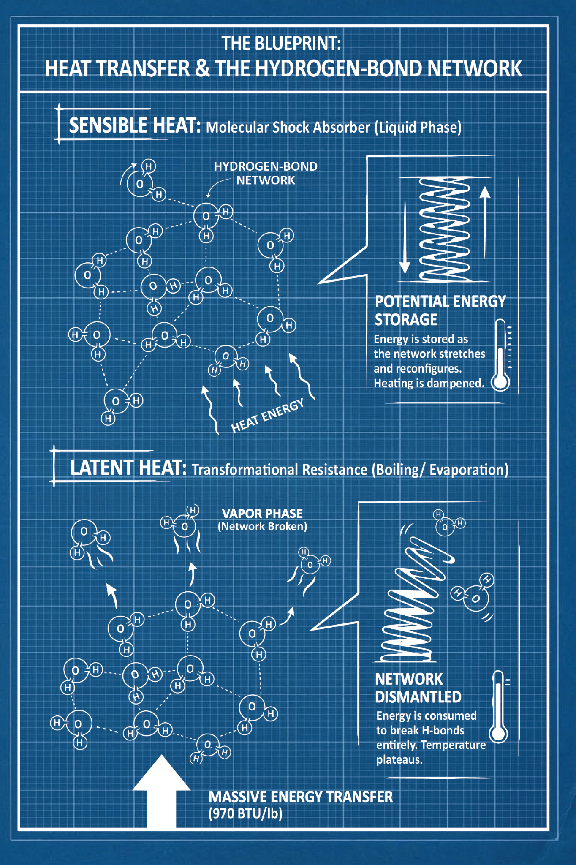
Water behaves differently. As energy enters liquid water, much of it does not immediately increase molecular motion. Instead, it is absorbed into the Hydrogen-Bond Network as potential energy. Bonds stretch. Configurations rearrange. Energy is stored in structure rather than molecular speed.
In effect, the network behaves like a molecular shock absorber.
As heat is absorbed, the network flexes, slowing the rise in temperature. As water cools, the network relaxes, releasing stored potential energy back into molecular motion, slowing the rate of cooling. This dampened response is not a flaw - it’s one of water’s greatest strengths as a heat transfer medium.
Rapid changes in temperature push other substances to their breaking point, while water self-regulates. It is why chilled-water loops stabilize buildings, why oceans moderate climate, and why hot-water loops can carry their heat through miles of piping without running cold.
But there is a limit to how much sensible heat can be absorbed as stored structure. This limit is defined by the boiling point of water, where the Hydrogen-Bond Network is maxed out. The bonds are stretched and molecular motion is intense. They have speed, but not freedom.
That final cost is the last act of resistance.
Latent Heat: Transformational Resistance
Once water reaches the boiling point, the most energetic molecules near the surface gain enough kinetic energy to break free into the vapor phase. As this occurs, they take their high energy with them and the average kinetic energy of the liquid left behind inevitably drops.
To prevent the temperature from falling, massive amounts of heat must be continually supplied to push the remaining slower molecules back to the breaking point.
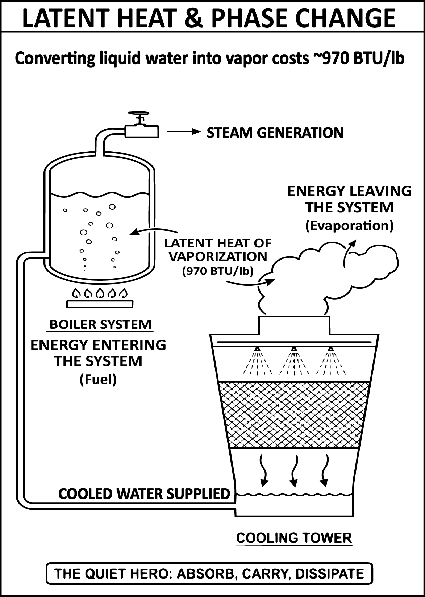
The energy required is the latent heat of vaporization, roughly 970 BTU/lb.
Latent heat is the energy required to pull water molecules out of the liquid network and into the expanded vapor phase. Most of that energy is spent overcoming intermolecular attraction, especially the Hydrogen-Bond Network, while some is spent pushing back against the pressure above the liquid.
This is nearly seven times more energy than it takes to raise one pound of water from room temperature to its boiling point (72°F → 212°F ~140 BTUs). This staggering disparity is the direct consequence of the Hydrogen-Bond Network resisting separation.
| CONCEPT LOCK 140 BTU to heat a pound of water to the brink. 970 BTU to turn that same pound into vapor. Latent heat is the energy required to pull water molecules out of the liquid network and into the expanded vapor phase. |
|---|
Pressure & the Payoff
Pressure raises the price of freedom.
Inside a boiler, pressure acts like a heavy lid pressing down on the liquid surface. Water molecules must push outward with enough force to not only break their hydrogen bonds, but also lift the weight of the pressure above them. This is why water in a high-pressure boiler does not boil at 212°F. It may need to reach 300°F, 400°F, or higher to gather enough internal muscle to fight its way free.
But that cost is not lost.
The energy added during vaporization is carried by the steam as stored thermal potential: molecules separated from the liquid structure, moving freely in the vapor phase, and occupying vastly more space. When that steam contacts a cooler surface and condenses, the Hydrogen-Bond Network reforms, the vapor collapses back into liquid, and that stored energy is released.
This is why steam is used to heat large campuses, sterilize medical equipment, and spin turbines. The latent heat of vaporization allows enormous quantities of energy to be transported efficiently and released precisely where needed.
In a boiler, fuel supplies the energy required to overpower the Hydrogen-Bond Network and lift the lid of pressure. Burning fuel pays the bill up front. The reward comes later – delivered wherever the steam condenses.
But this is not the only way to pay the bill. There is another source of energy, within the liquid itself, that covers the same cost by cooling things down.
Evaporative Cooling: Flipping the Script
Remember the chill as you stepped out of the pool? That was evaporative cooling. It is the same underlying mechanism as boiling, but paid for differently. And as your shivers suggest, it is happening all the time.
Above absolute zero (−459.67°F), water molecules are in constant motion. Occasionally, a molecule near the surface is struck from below with enough energy to escape into the vapor phase. At the system level, this separation requires the same latent heat of vaporization – 970 BTU/lb.
The escaping molecule enters the vapor phase freely.
The molecules left behind pay the price.
Their molecular motion and stored potential energy are transferred upward into the departing molecule. As a result, the Hydrogen-Bond Network loses stored configuration energy, molecular motion slows, and the temperature of the liquid drops.
This is the basis for why cooling towers are used – evaporation removes tremendous amounts of energy.
From this perspective, the water vapor leaving a cooling tower is not waste. It is energy being carried away from where it causes problems (the chiller or process loop) to where it does not (the atmosphere). Only a small fraction of water is required to remove massive amounts of heat.
The general rule of thumb is that evaporating 1% of the recirculating water cools the remaining bulk water by 10°F.
| CONCEPT LOCK Boilers pay for phase change with fuel. Cooling towers pay with evaporation. Same energy cost. Different source paying the bill. |
|---|
The Hero, Revealed
We use water to remove heat because it is beautifully designed to do so. Its molecular architecture leaves it no other choice.
Polarity creates bonds.
Bonds create resistance.
Resistance creates storage.
Storage enables control.
The storage - expressed as high specific heat and immense latent heat - is what allows water to absorb punishment from furnaces, compressors, data centers, and process equipment without flinching.
Other fluids can be pumped.
Others can be heated.
Others can boil.
No other everyday substance does all three with the grace, safety, and economy of water.
This is why water sits at the center of nearly every thermal system we build, and why industrial water treatment exists at all. Not to control water, but to protect its ability to move energy.
When we manage chemistry, control cycles, protect metallurgy, and prevent biological growth, we are not just solving maintenance problems. We are protecting against assaults on water’s superpower.
Water is not the hero that we deserve, but it is the hero we constantly need. It does not demand attention. It does not announce itself as essential. It shows up, absorbs energy, and carries it away. Relentlessly and reliably.
This quiet act is the foundation of life, climate, and modern industry.
⟵ 02 The Hero of Heat Transfer · Contents · 02 The Hero of Heat Transfer (Engineering Notes) ⟶