⟵ 03 The Solvent · Contents · 03 The Solvent (Engineering Notes) ⟶
The Solvent: Narrative
The Universal(ish) Solvent
In the last chapter, we saw what the Hydrogen-Bond Network allows water to build: a structure that absorbs heat, resists change, and moves energy across entire campuses.
This chapter is about what it allows water to break.
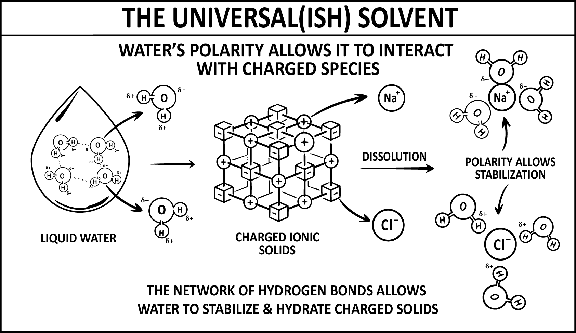
The same polarity that lets water molecules organize themselves into a dynamic, cooperative network also gives them the ability to reach outward – to pull on charges, test bonds, invade crystal lattices, and carry fragments of the world away in solution. The network makes that process flexible, allowing liquid water to continuously reorganize around whatever it grips.
When a salt crystal like sodium chloride enters water, the negotiation begins immediately. Water molecules orient their oxygen ends toward sodium ions and their hydrogen ends toward chloride ions, surrounding and stabilizing each one. If the energetic balance is favorable, the lattice is dismantled piece by piece, and the ions disperse into solution.
But not everything yields so easily.
Nonpolar substances lack strong electrostatic handles, offering very little for water to hold onto. Water forms only weak, fleeting interactions with them, leading to generally low solubilities.
Every surface that water touches must ultimately answer a question.
Will its bonds hold?
Will its lattice remain intact?
The answer depends not on water’s desire, but on the energetic balance of the encounter.
Water chemistry is simply the record of how those encounters resolve.
The Thermodynamic Negotiation
Every act of dissolution is a transaction.
Nothing dissolves for free.
To pull a solid into solution, water must overcome the forces holding that solid together. Only then can it recover that cost by stabilizing the separated species.
Whether dissolution occurs depends on three energetic terms.
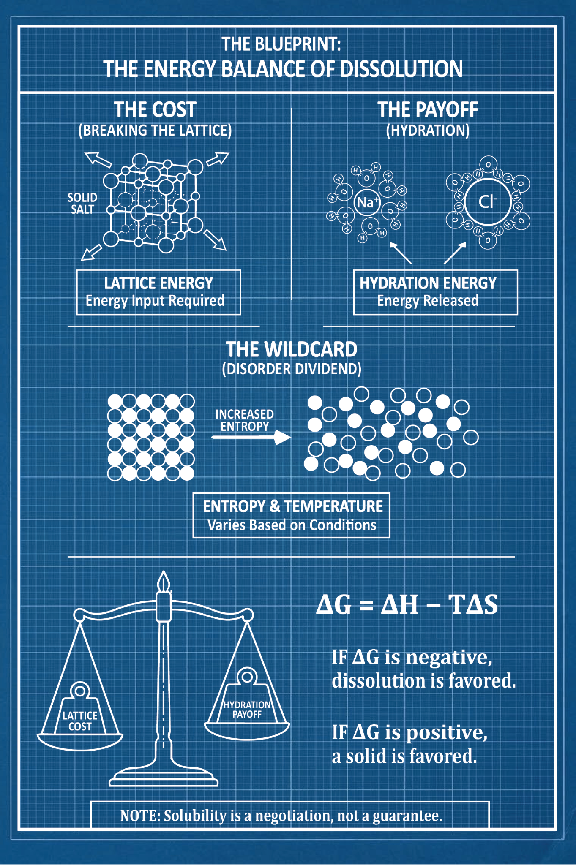
The Cost – Lattice Energy
Lattice energy is the energy required to pull ions apart from a crystal lattice.
A grain of table salt doesn’t look like much, but that speck is a fortress. Every ion inside it is clamped to its neighbors by electrostatic attraction, locked into a rigid grid where every positive charge is braced against a negative one. Nothing in there is loose. Nothing is waiting to leave.
To dissolve it, water has to take that fortress apart ion by ion.
Ionic solids exist because opposite charges stabilize one another in a low-energy arrangement. Breaking that arrangement requires energy. Strong electrostatic attractions – especially between highly charged, tightly packed ions – have a higher cost of entry. The tighter the grid, the more it costs to break in.
That price is the first thing water has to pay before anything dissolves at all.
The Payoff – Hydration Energy
Picture a single sodium ion the instant it breaks free of the crystal. It does not drift into empty space. The moment it is exposed, the nearest water molecules swing toward it and lock on – oxygen ends turning inward, crowding the ion on every side until it is buried inside a tight, shifting shell of water. The chloride ion gets the same treatment in reverse, hydrogens turning to face it, pinned in place by a cage of its own.
Oxygen points toward cations. Hydrogens point toward anions.
This is the embrace water offers in exchange for breaking the solid apart. The surrounding water molecules reorganize into hydration shells, creating local order around the separated ions. Those ion-water attractions stabilize the dissolved species and release energy back into the deal.
That release of energy is the payoff. It is what water collects for the work of dismantling the solid – and whether the deal is worth making depends on how generous that embrace turns out to be.
The Wildcard – Entropy
Entropy is the system’s preference for dispersion and mixing.
Add a single drop of dye into a still glass of water and walk away. Within an hour the color will spread in every direction, evenly, with no one stirring it. It will never gather itself back into a droplet of dye. Left alone, things spread out. The universe leans toward the scattered, the mixed, the disordered – and dissolution rides that current.
But there’s a catch you can’t see.
Dissolving a solid often increases the number of accessible arrangements in the system, which tends to favor dissolution. But hydration also imposes local order on the surrounding water, which is thermodynamically costly. Those tight shells that wrap each freed ion are organized – and building order out of chaos runs against the current. These two effects compete. Sometimes entropy favors dissolution. Sometimes it favors the solid state. Temperature determines how strongly this term matters.
That is what makes entropy the wildcard. It can push the deal forward or drag it back, and which way it leans depends on how much disorder the trade actually creates.
The Verdict – Gibbs Free Energy
Every dissolution carries a cost, offers a payoff, and gets nudged one way or the other by entropy. But the ion doesn’t weigh these one at a time. It feels all three at once, in a single moment, and the result is binary: it either leaves the solid or it stays.
Chemists settle that account with a single quantity called Gibbs free energy. You will never calculate it on a cooling tower. What you need from it is the direction it points.
These three terms come together in one equation:
ΔG = ΔH − TΔS.
Enthalpy (ΔH) tracks the balance between lattice disruption and hydration – the cost of breaking the solid versus the payoff of hydrating what comes loose.
Entropy (ΔS) tracks the system’s preference for dispersion and mixing.
Temperature (T) determines how heavily the entropy term is weighted.
The whole equation collapses to one question: did breaking the solid apart leave the system better off than leaving it whole? Add up the cost, the payoff, and the entropy, and you get a single number. Only its sign matters.
If ΔG is negative, dissolution is favored.
If ΔG is positive, the solid state is favored.
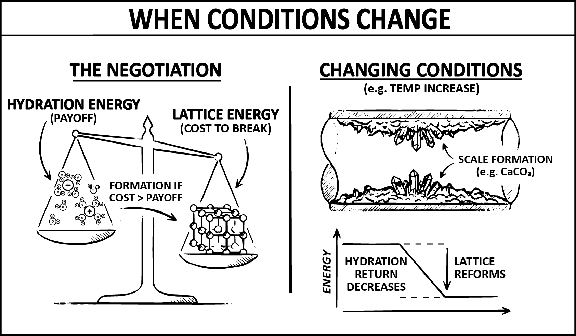
When you warm a tower and watch calcium drop out as scale, you are watching ΔG flip sign in real time. You don’t need the math to see it happen. You need to know which way it leans, and why.
Salt crystals don’t do calculations. They simply respond.
| CONCEPT LOCK Dissolution is a transaction. Lattice energy is the cost. Hydration energy is the payoff. Entropy can either assist or resist the deal. Gibbs free energy tells you which way it leans. Not all ions offer the same deal - and not all deals remain favorable under all conditions. |
|---|
These terms can feel abstract until we watch them play out in real substances.
Chloride, carbonate, and silica reveal three very different outcomes. Chloride shows water at its most effective: gripping, separating, and carrying ions away with ease. Carbonate shows a more difficult negotiation, where the solid often resists and may re-form when conditions shift. Silica changes the terms entirely. It is not simply harder to dissolve – it is built differently.
Why Chloride Salts Dissolve So Easily
Chloride makes an attractive offer.
It carries a single negative charge spread over a comparatively large ion, which weakens its attraction to neighboring cations in a crystal lattice. This keeps the cost of separation manageable, especially when chloride is paired with common monovalent cations like sodium or potassium.
Once separated, chloride is also readily hydrated. Water molecules can stabilize its charge without extreme reorganization, and the dispersion of separated ions through the solution gives entropy a powerful reason to favor the dissolved state.
Manageable cost. Sufficient payoff. Entropy pushing the deal forward.
That combination is why many chloride salts dissolve readily and remain highly soluble across a wide range of conditions.
Why Carbonate Salts Make Scale
Carbonate is a much tougher negotiation.
It carries a double negative charge concentrated in a rigid, planar structure. In a crystal lattice, that charge can bind powerfully with divalent cations like calcium. Pulling calcium carbonate apart therefore requires a much higher energy investment than pulling apart a simple salt like sodium chloride.
Water can stabilize carbonate once it is separated, but the hydration payoff is often not enough to overcome the strength of the calcium carbonate lattice. The system sits close to a threshold, where changes in temperature, pH, alkalinity, calcium concentration, or carbon dioxide can push the balance back toward solid scale.
High cost. Conditional payoff. Fragile balance.
That is why calcium carbonate dissolves reluctantly and precipitates eagerly when conditions shift. Carbonate does not simply dissolve poorly. It waits near a thermodynamic edge, ready to return to the solid state when the water can no longer keep the deal favorable.
Why Silica Is Different
Silica changes the rules.
Chloride and carbonate are ionic compounds. Their charges are discrete enough for water to recognize, surround, and stabilize. The deal may be easy or expensive, but it is still the kind of deal water is designed to make.
Silica is different.
In quartz (SiO2) and many silicate minerals, the solid is not built from separable positive and negative ions. It is built from an extended covalent Si–O framework, where electrons are shared across the structure rather than localized on individual ions waiting to be pulled apart.
Water’s usual strategy – surrounding charge and stabilizing separation – has very little to work with.
Water has almost nothing to grip.
A small amount of silica does dissolve, reacting slowly with water to form silicic acid (H₄SiO₄ or SiO2⦁2H2O). But this is less like true ionic dissolution and more like a gradual surface reaction: water chipping away at its edges, one unit at a time.
That distinction matters.
Much of Earth’s crust is made of silica and aluminosilicate minerals built on this same stubborn framework. Water can weather them, transport them, and sometimes carry them as colloidal or polymeric material – but it struggles to dismantle them completely.
How Temperature Influences the Negotiation
Temperature complicates the deal.
As temperature rises, the entropy term carries more weight. Atoms and molecules move faster, collide more often, and reorganize more readily. This generally favors dispersion.
But warming water also strains the Hydrogen-Bond Network. As the network becomes more disordered, water becomes less effective at stabilizing separated charge. Hydration becomes more difficult and less rewarding.
Which effect dominates depends on the substance.
For salts with manageable lattice costs and favorable dispersion, such as sodium chloride, dissolution remains favorable. For calcium carbonate, the balance is more fragile. Heating weakens hydration, shifts carbonate equilibrium, and drives carbon dioxide out of solution. Together, those changes make the solid state more favorable.
This behavior is known as inverse solubility, or retrograde solubility.
Silica behaves differently again. Its solubility does increase with temperature, but the gains are modest. Warming can accelerate the surface reactions that slowly chip silica into solution, but it cannot solve the underlying problem: there are no discrete ions for water to surround and hydrate.
The Balance That Determines Solubility
The rules behind that verdict never change: the cost of breaking a lattice, the hydration payoff, the entropy of dispersion. What changes is the chemistry.
Real systems are too crowded and interconnected to solve from first principles every time. Boilers and cooling towers contain dozens of dissolved ions, shifting pH, changing speciation, temperature swings, gas exchange, and ionic-strength effects, all happening at once. The full calculation becomes impractical.
But the logic still holds.
Solubility is not a personality trait of a salt. It is the verdict of an energy negotiation. The inputs change with every shift in water chemistry, but the framework for predicting the outcome does not.
The Three Fates of Matter
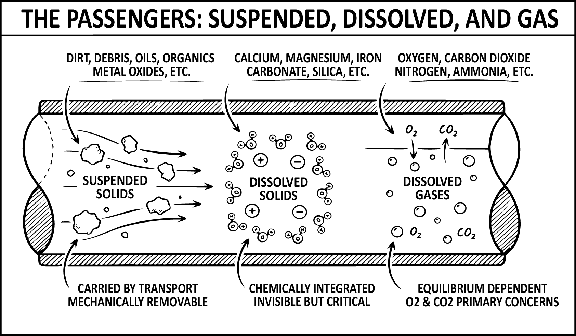
By the time water has completed the journey from vapor to solution, everything it carries falls into three fundamentally different categories.
They are defined by the outcome of the encounter: what water leaves intact, what it dismantles, and what it holds in equilibrium.
Suspended Solids
Suspended solids – measured as Total Suspended Solids (TSS) – are materials water does not dissolve.
Their internal bonds are too strong, too directional, or too incompatible with water’s structure to be dismantled. The energy balance does not favor dissolution, so the solid survives the encounter. Water flows around these particles rather than through them, interacting only at their surfaces. Their behavior can be influenced by chemistry, but their presence is governed primarily by transport.
Suspended solids include soil, silt, clay, algae, bacteria, and plankton. They are most common in surface waters, where rivers and creeks mechanically carry material downstream. Whether they remain suspended depends on flow conditions, turbulence, particle size, density, and surface forces.
Though not dissolved, their presence matters. Suspended solids foul heat exchangers, scatter light, shield microorganisms from disinfectants, and provide surfaces where biological and chemical processes can take hold. Most suspended solids fall in the range of 2–100 microns. For perspective, the diameter of a human hair is about 70 microns - roughly the resolution limit of the naked eye.
Suspended solids are visible.
They are tangible.
They are mechanically removable.
Dissolved solids are a different matter entirely.
Dissolved Solids
Dissolved solids – measured as Total Dissolved Solids (TDS) – are species that water has fully dismantled and incorporated.
These are ions and small polar species that interact directly with water at the molecular level. Once dissolved, the original solid no longer exists. The species distribute uniformly throughout the solution, invisible to the naked eye and inseparable by conventional filtration.
Surface waters generally carry modest concentrations of dissolved solids, reflecting limited contact time with minerals in flowing streams. Groundwater tells a different story. As water filters slowly through geological formations, suspended solids are stripped away, but dissolved minerals accumulate steadily over years or decades of contact.
The result is water that looks clear but carries a strong chemical signature.
Most dissolved solids relevant to water treatment are inorganic ions: calcium, magnesium, sodium, potassium, bicarbonate, sulfate, chloride, and dissolved silica. These species are typically smaller than 0.002 microns and govern scaling tendency, corrosion behavior, buffering capacity, and electrical conductivity.
They do not merely travel with the water.
They become part of it.
But not everything enters water through the dismantling of a solid. Some substances follow a different set of rules.
Dissolved Gases
Water also dissolves gases but by a different mechanism.
For most gases, the governing force is physical equilibrium. Gas molecules continuously enter and leave the water at the surface until a balance is reached between the gas above the water and the gas within it. At a fixed temperature, the amount held in solution is proportional to the gas’s partial pressure above the solution. This relationship is captured by Henry’s Law:
C = kH × P
Most atmospheric gases – like nitrogen (N₂) and oxygen (O₂) – are nonpolar. Once dissolved, they offer little charge for water to stabilize, and their interactions with the Hydrogen-Bond Network are weak and fleeting. As a result, their solubility is limited and highly sensitive to changes in temperature and pressure. Warm the water and most gases become less soluble. Reduce the pressure and they escape. Agitate the surface and they leave faster.
Two gases matter most in water treatment.
Oxygen (O₂) does not react with water itself, but once present it becomes an aggressive participant in oxidation reactions – especially corrosion.
Carbon dioxide (CO₂) goes a step further. When it dissolves, a portion converts to carbonic acid, shifting pH and carbonate chemistry.
We will return to oxygen and carbon dioxide in later chapters. For now, it is enough to recognize this: dissolved solids are carried by hydration; gases are governed by equilibrium.
The Passengers
Of these three categories, dissolved solids create the most persistent control problem in industrial water systems.
Suspended solids can often be filtered.
Dissolved gases can often be stripped or controlled through equilibrium.
Dissolved ions are different.
Once incorporated into the liquid, dissolved ions become part of the water itself. They do not vanish, but they do become invisible.
The Engineering Notes that follow will show you how we measure and track them. But measurement alone cannot tell you what water will do. Two waters with identical conductivity can behave entirely differently – one scaling aggressively, another corroding metal. The difference is not how many ions are present, but which ones.
Every process we care about – solubility, corrosion, scaling, biological activity – is arbitrated by a single ion. It is the smallest atom in existence, and yet its influence can be extraordinary.
To understand what water will actually do, we must understand the Power of Hydrogen.
That is where we turn next.
⟵ 03 The Solvent · Contents · 03 The Solvent (Engineering Notes) ⟶