⟵ 04 The Power of Hydrogen · Contents · 04 The Power of Hydrogen (Engineering Notes) ⟶
The Power of Hydrogen: Narrative
Brewing Beer: A Chemist with a Problem
In the early 1900s, Søren Peter Lauritz Sørensen worked as a chemist at the Carlsberg Laboratory in Copenhagen - a research institution founded specifically for the science of fermentation.
Sørensen was not trying to revolutionize chemistry, but he was motivated by a noble cause: brewing consistent beer.
Fermentation has always been an extremely sensitive process. Yeast responds sharply to subtle chemical shifts, and brewers had long known that acids and bases exerted a profound influence. The problem was measurement. Chemists could tell acidity mattered, but they lacked a practical way to say how much.
The litmus test had existed for centuries, using dyes extracted from lichens to signal acidity or alkalinity through changes in color. It was simple, fast, and profoundly imprecise. Litmus could tell you whether something was acidic, but not by how much.
Fortunately for Sørensen, laboratory instrumentation was finally catching up with chemical curiosity. Electrode methods made it possible to relate hydrogen-ion behavior to measurable voltage. For the first time, acidity could be treated as a quantity, not just a color change.
The level of acidity was now measurable. But it was also unmanageable.
The concentrations involved were extraordinarily small, buried beneath six or seven decimal places. Worse still, meaningful chemical differences spanned enormous ranges. The numbers were finally accurate, but they were difficult to use.
Sørensen’s great insight was to change the shape of the data.
Rather than painstakingly transcribing strings of decimal places, he compressed hydrogen-ion concentration into a compact logarithmic scale.
He called the result pH.
The exact meaning of ‘p’ is still debated – perhaps “power,” perhaps “potential.” Whatever Sørensen intended, the effect was the same. He had taken concentrations that could span a hundred trillionfold across the familiar 0-to-14 range and folded them into a deceptively tidy scale.
That compression is what makes pH useful.
It is also what makes it dangerous.
pH allows us to manage perhaps the most consequential ion in water treatment, but only if we remember what the number actually represents. It is not an amount of acid. It is not an amount of caustic. It is the position of hydrogen in an equilibrium system, squeezed onto a deceptively simple scale.
Like so many things, I learned this lesson the hard way.
Learning pH the Hard Way
It was near midnight in a dim mechanical room, once again, but I was not alone. Three coworkers stood silently beside me, staring in disbelief at the mess I had just made.
I had completely over-neutralized about three hundred gallons of acid.
We were cleaning the condenser barrel of a neglected chiller using inhibited hydrochloric acid. Years of calcium carbonate scale deposition had narrowed flow paths and crippled heat transfer. Mechanical cleaning wasn’t an option. Acid was our only recourse.
Acid cleaning works because hydrogen is relentless. High concentrations of hydrogen ions attack the ionic lattice formed between calcium (Ca²⁺) and carbonate (CO₃²⁻). Carbonate is converted to bicarbonate, then to carbonic acid, and finally released as carbon dioxide gas. The solid scale disappears into solution, bubbling its way out of existence.
We circulated the acid through the chiller barrel and into a large external storage tank, which off-gassed ferociously. Our target cleaning pH was 1 - an extremely aggressive condition.
At that pH, hydrogen dominates completely. Carbonate cannot exist. Carbonate scale cannot survive. But metal does not like it either.
This is why acid cleanings aren’t the simple procedure that many mechanical contractors treat them as. They remove years of working life from internal surfaces in a single afternoon. To help combat this, we added high doses of corrosion inhibitors while hydrogen did its work.
For hours, we watched the storage tank bubble. Calcium climbed rapidly as scale dissolved, reaching several hundred parts per million. Meanwhile, the pH crept slowly - from 1 to about 2.5 - as hydrogen was consumed by the carbonate reaction. When both numbers plateaued, we knew the cleaning was complete.
Now it was time to neutralize.
Local discharge requirements demanded a pH between 5 and 11. I calculated what should have been enough 30% potassium hydroxide to raise the pH safely to 6.
This step was critical. Neutralization is mandatory, but over-neutralization is catastrophic. As pH rises, the carbonate system begins shifting back toward scale-forming chemistry. Carbonic acid gives way to bicarbonate, and at higher pH, bicarbonate shifts toward carbonate. With calcium already present at extreme concentrations, calcium carbonate can re-form instantly, undoing hours of work in seconds.
To limit the risk, the storage tank was disconnected from the condenser barrel. We would neutralize only the three hundred gallons in the storage tank, discharge it safely, and then deal with the remaining volume in the chiller. Thank goodness we did.
I added the calculated dose of potassium hydroxide and stirred. The pH barely moved from 2.5 to 3.5. I was hungry, frustrated, and tired. I assumed the volume estimate for my calculation was off, so I added more caustic. A lot more.
Despite knowing better, I got lost in the pH sauce**.** And of course, I did it at the exact moment the customer walked in.
“How’s it going?” they asked.
I dipped my meter into the tank and watched it settle at pH 13.4.
“Oh shit.”
I knew exactly what I had done. I had failed to respect the logarithm.
The first dose of potassium hydroxide had reduced hydrogen concentration by a factor of ten, but the pH only moved one point. My lizard brain saw ‘one point’ and thought ‘add more.’ I didn’t realize that I had already reduced the hydrogen concentration by 90%. The next dose didn’t have a battle to fight - it walked into an empty room.
The tank turned a putrid black as hydroxides reacted violently with the dissolved metals stripped from the chiller surfaces. Clouds of white calcium carbonate scale began precipitating out of solution.
“We’re almost finished,” I replied to the customer, lying through my teeth. In a moment of grace, they simply nodded and left.
We had used all of our acid in the cleaning process, so there was no easy way to lower the pH of our storage tank to meet the discharge requirements. Fortunately, the highly acidic solution remained in the chiller barrel. We drained small amounts into the empty acid drums and slowly mixed them with portions of the caustic storage tank. Drum by drum - fifty-five gallons at a time - we fought a total of seven hundred gallons of solution back into equilibrium.
It took us nearly seven hours to clean up the molecular mess I’d created in seconds.
We were extremely lucky to have isolated the storage tank. Had we neutralized the entire system at once, scale would have re-formed inside the chiller - leaving it worse off than when we started.
The experience was embarrassing and became a long-running joke in our office: don’t let Connor neutralize.
But it also became a hard-earned lesson.
pH is not a measure of how much chemical you add.
It is a measure of how far equilibrium has been forced to move.
What pH is Trying to Tell Us
If you ask a room full of water treaters what pH measures, the first answer you’ll usually hear is simple enough: “hydrogen concentration.”
That answer is not wrong. By definition, pH is the negative base-ten logarithm of hydrogen ion concentration:
pH = −log10[H⁺]
But that definition only tells us how the number is calculated. It does not tell us why the number matters.
The reason pH matters is that hydrogen is not like other dissolved ions.
Calcium, sodium, chloride, sulfate, and bicarbonate all carry electron clouds with them. Hydrogen does not. Once hydrogen loses its electron, what remains is just a proton: a bare unit of positive charge. It is the smallest thing we manage directly in water treatment, and it is one of the most reactive.
The instant a hydrogen ion appears in water, it does not remain alone. It grabs onto a neighboring water molecule and forms hydronium:
H⁺ + H₂O → H₃O⁺
That extra positive charge does not stay politely in one place. It moves through water by hand-off, passing from molecule to molecule through the Hydrogen-Bond Network. Hydroxide moves with similar speed in the opposite direction, accepting and passing proton “holes” through the liquid.
This makes hydrogen and hydroxide different from ordinary dissolved ions. Sodium drifts through water. Calcium drifts through water. Chloride drifts through water.
Hydrogen and hydroxide race.
They also react with each other almost instantly:
H⁺ + OH⁻ → H₂O
That is the key to pH.
When we measure hydrogen, we are not just measuring one ion. We are measuring one side of a linked equilibrium. At a fixed temperature, hydrogen and hydroxide are tied together so tightly that knowing one tells us the other.
pH is useful because one number tells us where that balance sits.
pH is dangerous because that number hides the size of the shift.
When Water Falls Apart
Water is a very stable molecule.
It takes a lot of energy to break the O-H bond holding it together, which is exactly why the reaction between H+ and OH- is so favorable. But stable does not mean permanent. Water molecules endure relentless collisions with their neighbors, and once in a great while, the Hydrogen-Bond Network pulls hard enough for one water molecule to hand a proton to another.
This is why chemically pure water carries an electrical conductivity around 0.055 µS/cm. A vanishingly small number of hydrogen and hydroxide ions are constantly formed by water reacting with itself.
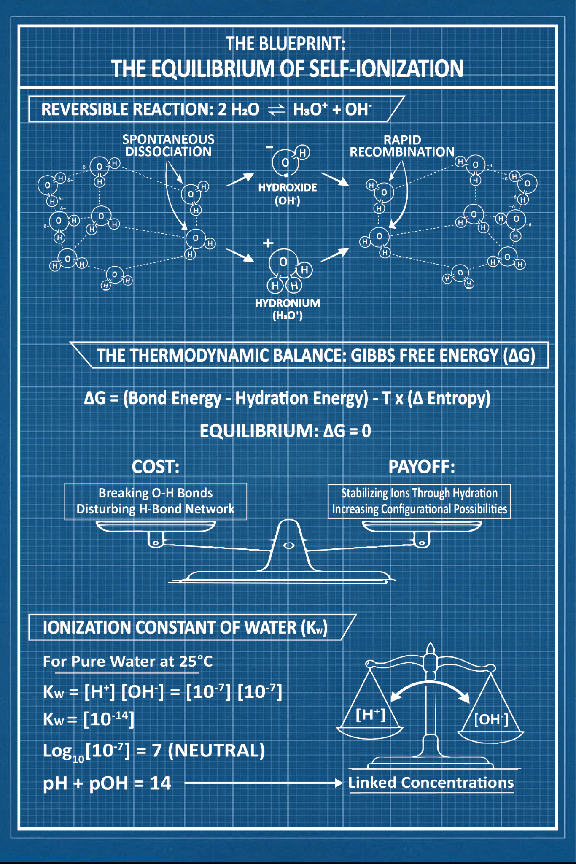
H₂O ⇌ H⁺ + OH⁻
Or, written more honestly to account for hydrogen as hydronium:
2 H₂O ⇌ H₃O⁺ + OH⁻
This process is called self-ionization. It is extremely rare – about one molecule in 555 million is split into ions at any given instant – but it never stops. It is also reversible. The hydronium and hydroxide ions formed by the reaction diffuse rapidly and recombine almost immediately to create new water molecules.
At equilibrium, the forward and reverse processes occur at equal rates.

That is what equilibrium means here.
Not stillness.
Not chemical silence.
Just equal traffic in both directions.
At 25°C, that traffic in pure water settles at a familiar place:
[H⁺] = [OH⁻] = 10⁻⁷ mol/L
This equilibrium condition determines the pH of neutral water:
pH = -log10[H+] = -log10[10-7] = 7
That is why neutral pH is 7. It was not chosen because seven is a lucky number. It falls straight out of the measured behavior of water. And because the concentrations of hydrogen and hydroxide ions are linked, it also imposes a strict constraint called the self-ionization constant:
Kw = [H⁺][OH⁻] = 10⁻¹⁴ at 25°C
Their concentrations are not independent dials. They are tied together: push one up and the other must fall to maintain the constant.
The specific value of Kw changes with temperature, but the requirements remain the same. As water is heated, self-ionization increases and Kw rises. Because [H⁺] and [OH⁻] rise together, neutral pH slides downward: more hydrogen, lower pH. Neutral is not always pH 7. Neutral means hydrogen and hydroxide are equal.
Pure water remains evenly balanced, but that doesn’t last for long. The moment that rain condenses from the sky, water begins absorbing gases that increase acidity and force the
equilibrium to adjust. Once the water reaches our systems, it encounters other contaminants that contribute to the fray.
| CONCEPT LOCK Pure water is not chemically empty. It continually forms tiny amounts of H⁺ and OH⁻. At 25°C, neutral water has equal concentrations of both: [H⁺] = [OH⁻] = 10⁻⁷ mol/L. Hydrogen and hydroxide are linked by water’s ionization constant: Kw = [H⁺][OH⁻] = 10⁻¹⁴. Disturb one, and the other must respond. |
|---|
The Equilibrium Tug-of-War: Acids and Bases
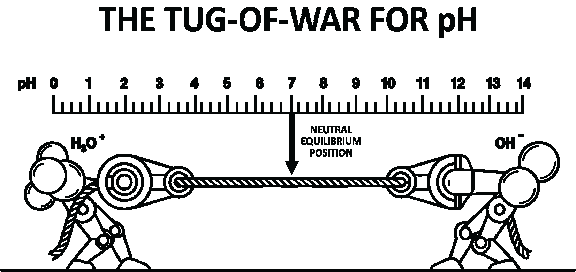
The self-ionization constant dictates a strict law of coexistence: hydronium and hydroxide are not allowed to remain abundant at the same time. Increase one, and the other is driven down until the constant is restored.
This creates a tug-of-war.
Acids and bases pull on opposite sides.
When acids are added, hydronium is reinforced. Hydrochloric acid splits cleanly the moment it touches water:
HCl → H⁺ + Cl⁻.
The flood of new protons reacts with the available hydroxide almost immediately, and the OH⁻ population collapses. Hydroxide can no longer hold the same line, and the pH shifts acidic. A new equilibrium is established with excess hydronium and deficient hydroxide.
When bases are added, the pull is reversed. Caustic gives up its hydroxide:
NaOH → Na⁺ + OH⁻
Now it’s hydronium that gets hunted down and folded back into water. The proton population plummets, and the pH shifts basic.
In both instances, the rules remain the same. At 25°C, the product of the two concentrations must return to Kw:
[H⁺][OH⁻] = 10⁻¹⁴
Acids and bases do not change the underlying rule. They drag the equilibrium to a new resting place.
All of this makes pH a brilliant convenience: one probe, one number, and at a known temperature, you can determine both concentrations. But the logarithm that makes pH so easy also lays a trap. It compresses enormous changes into one quiet step on the scale. For every unit change in pH, hydronium and hydroxide change tenfold in opposite directions.
That is exactly what cost me and my coworkers one of the longest field days I can remember. I did not misunderstand the definition of pH. I misunderstood the size of the movement hidden inside one quiet step on the scale.
Resistance to Change
The interdependence of hydrogen and hydroxide is clear. If hydrogen rises, hydroxide must fall. If hydroxide rises, hydrogen must fall.
But that does not mean the water resists change.
pH is not a buffer. It is a measurement of where the equilibrium currently sits. A real buffer resists pH movement by providing chemical species that can consume added acid or added base before hydrogen concentration swings wildly.
That distinction matters constantly in the field.
A high-pH solution can still have very little reserve capacity. Add acid, and the pH may collapse almost immediately. A lower-pH solution with strong buffering may absorb a significant acid dose before the pH moves much at all.
Alkalinity is the most common buffering system in natural waters. It works through weak acids and conjugate bases, most importantly the carbonate system, that can absorb disturbances from both directions. We will explore that equilibrium in the next chapter. For now, the important point is simple:
pH describes the current intensity of equilibrium.
Alkalinity describes the future capacity to resist change.
The Math of the Mistake
It’s easy to underestimate the pH scale.
I did exactly that when I over-neutralized my chiller by a factor of one million.
The numbers are small. The changes appear modest. But this is an illusion created by logarithms.
When I began neutralizing the chiller, the circulating solution sat at a pH of 2.5. That corresponds to a hydrogen concentration of roughly 3.2 × 10⁻³ moles per liter – an aggressively acidic environment, but one that was chemically stable as long as hydrogen dominated the system.
As I added potassium hydroxide to the storage tank, the strong base dissociated immediately. The unbound hydroxide ions did what they always do: hunt down free hydrogen and turn it into water.
H⁺ + OH⁻ → H₂O
The pH barely moved, stabilizing at 3.5.
Although I damn well knew it was logarithmic, the linear programming of my lizard brain took over. It told me I had barely made a dent.
In molecular reality, I had already reduced the hydrogen concentration by almost 90%.
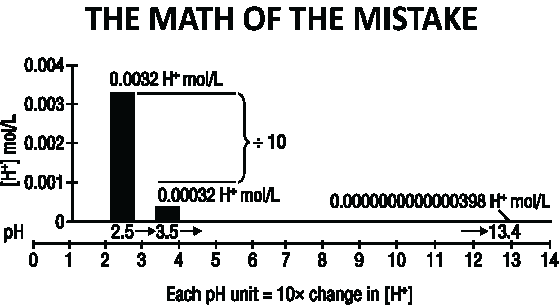
pH 2.5 = 3.2 × 10⁻³ mol/L H⁺ and 3.2 × 10⁻¹² mol/L OH⁻
pH 3.5 = 3.2 × 10⁻⁴ mol/L H⁺ and 3.2 × 10⁻¹¹ mol/L OH⁻
pH 7.0 = 1.0 × 10⁻⁷ mol/L H⁺ and 1.0 × 10⁻⁷ mol/L OH⁻
Once neutralization is reached, the battlefield shifts dramatically. Hydroxide takes the high ground, and its concentration begins to skyrocket.
The pH didn’t walk to 13.4.
It teleported.
pH 13.4 = 4.0 × 10⁻¹⁴ mol/L H⁺ and 2.5 × 10⁻¹ mol/L OH⁻
The logarithmic compression of the pH scale hid the impact from my hungry lizard brain. I wasn’t adjusting a volume knob, I was redistributing molecular populations by orders of magnitude.
| CONCEPT LOCK Each one-unit change in pH represents a ten-fold change in [H+] and [OH⁻] concentrations. The scale compresses enormous chemical shifts into small numbers. Small pH moves can hide enormous chemical changes. |
|---|
Why a Small Number Runs the Entire System
The actual concentrations of hydrogen and hydroxide in most water systems are tiny compared to the concentrations of calcium, alkalinity, chlorides, sulfates, or dissolved solids we usually worry about. But pH still controls the rules of engagement.
A small shift in pH can completely alter what chemistry is allowed to happen.
Take chlorine. Free chlorine lives as two species in balance – hypochlorous acid (HOCl) and the hypochlorite ion (OCl⁻) – and the split between them sits right around pH 7.5.1 They are not the same disinfectant. At pH 7, free chlorine is mostly HOCl, the uncharged form that slips through cell walls, and your kill rates are strong. At pH 8.5 it is mostly OCl⁻, and you are feeding far more chlorine to do far less work. The meter reads “1.0 ppm free chlorine” at both. The chemistry behind the number is not the same.
Take corrosion. Carbon steel in a closed loop leans on a thin film of magnetite (Fe₃O₄) that holds together in alkaline water and dissolves as pH falls. Let a loop drift toward neutral and you have invited the system to put its own iron back into solution.
Take scale – the exact trap that bit me at 13.4. Calcium carbonate solubility rides on the carbonate balance, which is strongly controlled by pH. Raise the pH and more bicarbonate shifts toward carbonate; calcium finds that carbonate and the water moves closer to scale. Lower the pH and the same calcium can remain comfortably dissolved. Two waters at pH 7.8 and 8.6 can read identical on a hardness test and behave like completely different fluids on a heat exchanger.
Biology pays the same tax. Enzymes, membranes, and whole metabolic pathways live inside narrow proton ranges. Push far enough and the microbiology simply stops cooperating – for better or worse, depending on what you wanted from it.
So pH is never just one more box on the log sheet. It decides which reactions are allowed to run in the water in front of you. It reorganizes the chemistry.
The Smallest Thing We Manage
The hydrogen ion – a bare unit of positive charge – is the smallest thing we are ever asked to manage directly. Despite its size, it is among the most consequential.
It cannot sit still – the instant it appears it grabs at whatever is nearest, and it never stops reacting. It cannot stay alone – it is bound to hydroxide by a constant neither can escape, one rising as the other falls. And it cannot be outrun – it hands itself off from molecule to molecule, racing through the water faster than anything else dissolved in it. Between a pH of 0 and 14, its concentration swings by a factor of a hundred trillion. And yet, a single dip of a probe tells us exactly where that balance stands.
That is the thing to hold onto. A pH reading is not a tally of how much acid or caustic you poured in – it is a position, the spot where the most restless charge in your water has settled for this instant. Read it as a position and it will tell you almost everything worth knowing about your system: what will scale, what will corrode, what will grow, and what your chlorine is actually doing. Mistake it for a quantity – or haphazardly adjust it – and it will teach you what it really is. Fast, and not gently.
I learned it at pH 13.4, with the customer standing in the doorway. It is a lesson worth learning before midnight in a mechanical room.
⟵ 04 The Power of Hydrogen · Contents · 04 The Power of Hydrogen (Engineering Notes) ⟶
Footnotes
-
The pH dependent equilibrium between hypochlorous acid (HOCl) and hypochlorite ion (OCl-), with a pKa near 7.5 at 25 C. See White’s Handbook of Chlorination and Alternative Disinfectants (Black and Veatch). Confirm the edition and page at time of publication. ↩