⟵ 06 Destructive Oxidation · Contents · 06 Destructive Oxidation (Engineering Notes) ⟶
Destructive Oxidation: Narrative
Familiar Oxidation
Oxidation is nothing new at this point.
We have already seen it in its most cooperative form: sodium giving up an electron to chlorine to form sodium chloride. Oxidation is loss of electrons. Reduction is gain of electrons. Together, they form a redox reaction.
In sodium chloride, the exchange behaves like a clean transaction. Chlorine offers a favorable home for the electron, sodium gives it up readily, and the resulting compound is stable. Nothing useful has been destroyed. No pipe wall has thinned. No cell membrane has ruptured. No engineered structure has lost its function.
But most oxidation in water systems is not so polite.
Most materials we care about – metals, polymers, living cells – depend on electrons to maintain their structure. When electrons are stripped away from those structures, the material is forced into a new chemical identity. Once that happens, the original structure does not spontaneously return under the conditions of the system.
This is the dividing line.
Transactional oxidation is electron exchange.
Destructive oxidation is electron theft from a structure that needed those electrons to remain useful. Destructive is not a separate kind of redox chemistry. It is what we call oxidation when electron loss destroys the function of something we care about.
| CONCEPT LOCK Transactional oxidation is an exchange. Destructive oxidation is a theft. When electrons are removed from structures that depend on them, the original material ceases to exist. The damage persists because the original structure does not spontaneously rebuild under system conditions. |
|---|
The First Rule of Destructive Reactions…
To understand destructive chemistry, we only need to look at the scar it leaves behind.
There is a scene in the movie Fight Club that captures this perfectly. Tyler Durden takes the narrator’s hand, kisses it, and then pours industrial lye (NaOH) over the wet mark. As the powder activates, eating into the skin, the narrator accepts his fate and is left with an unmistakable scar – evidence that something permanent has happened.
Sodium hydroxide is a strong base, not an oxidizer. It does not steal electrons. Instead, it tears apart the molecules that hold living tissue together, turning them into soap. The narrator’s skin does not burn because it is oxidized – it burns because the fundamental architecture of the tissue is being dissolved.
Once those structures are broken, the damage cannot simply be undone. The body can heal around it, but it cannot reverse what the reaction changed. The scar remains as proof that the chemical transformation does not simply reverse itself.
This is the rule.
Acids, bases, and oxidants attack matter in different ways. But when the damage is destructive, the defining feature is always the same: the reaction produces something that will not spontaneously go back to what it was.
In theory, any sufficiently aggressive chemistry can produce destructive change. In practice, water systems do not experience all chemistries equally. They experience one relentlessly.
Destructive Oxidation
Oxidants provide the voltage that destroys.
Their high reduction potentials exert electrochemical pressure on everything they touch. The higher the reduction potential, the stronger the drive to consume electrons.
When they meet a material that holds its electrons more loosely, the gap in wanting becomes a force, and the force tears electrons away.
In nearly every material we care about in industrial water systems, those electrons are structural. They are load-bearing. They hold metal lattices intact, stabilize organic molecules, and maintain the membranes and enzymes that make life possible. Take them away and the structure does not dent – it becomes something else.
This is destructive oxidation: forced electron loss that leaves behind a new form of matter, more stable and less useful than what it replaced. In water systems, two kinds of structure pay the price most often.
Living Cells: Oxidation as Biological Destruction
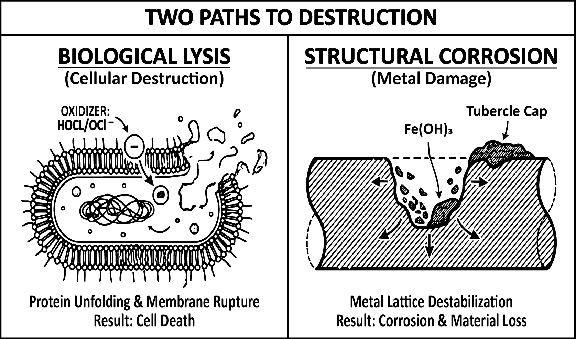
A bacterial cell is a structure held together by electrons in the right places. Its membrane is a wall of lipids, lined up and stable. Its proteins are folded into precise shapes, and the folds are what make them work. Its enzymes hold electrons in exact positions, like keys cut to a single lock.
An oxidizer pulls those electrons out.
The membrane lipids break and the wall springs leaks. The proteins lose their folds and slump into useless shapes. The enzymes, missing the electrons that defined them, stop fitting the locks they were cut for. The DNA takes hits it cannot read past.
At a biocidal dose, the cell cannot patch this fast enough. Oxidation does not merely knock a piece loose for the cell to glue back. It changes what the piece is. Once enough lipids, proteins, enzymes, and genetic material have been oxidized, the cell dies because its identity has been edited, not just damaged.
This is why oxidation is one of the most reliable kill mechanisms in water treatment. Life is electron arrangement. It cannot survive forced electron loss.
Metals: Oxidation as Structural Collapse
A metal is a crowd of atoms sharing a pool of electrons. The atoms sit in a fixed lattice, rigid and ordered, and the shared electrons drift freely between them. That shared pool is the glue. It is what makes steel stiff, what lets copper bend without snapping, what holds the whole structure together as one solid thing.
An oxidizer drains the pool.
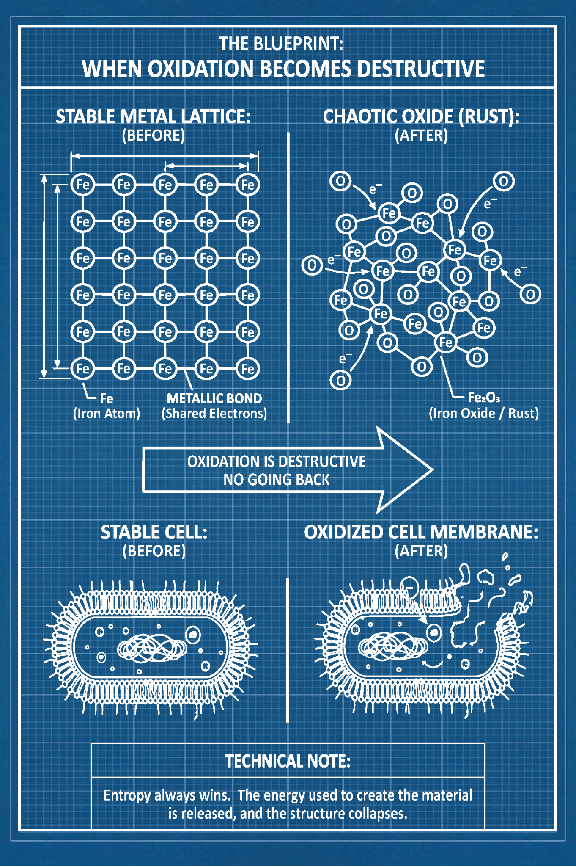
As electrons leave the lattice, the metallic bond weakens. Atoms that were part of the shared electron structure become metal ions: Fe gives up two electrons and becomes Fe²⁺, Cu becomes Cu²⁺. Once that happens, they are no longer part of the original metal. They leave the structure behind and react into oxides or hydroxides built from the wreckage.
That new growth is rust. And rust is not the old metal wearing a coat of damage – it is a different material entirely, with its own density, its own brittleness, its own shape. It flakes where steel held. It crumbles where steel carried load.
The metal cannot climb back out of this. The atoms that left the lattice are now bound into a more stable compound, sitting at lower energy, with no path that runs the reaction backward on its own.
This is why corrosion is destructive chemistry. Once the electrons leave the lattice, the metal you started with no longer exists.
One Mechanism, Two Outcomes
This raises an unfortunate downside to the use of oxidizers.
The same electrochemical force that destroys a bacterial cell will also attack a steel tube. Oxidation does not distinguish between biology and metallurgy - it only follows the path of electron availability.
This is why oxidants are both indispensable and dangerous in water treatment. When we add them intentionally - chlorine, bromine, ozone, peroxide - we walk a fine line. These molecules do exactly what they are designed to do: they take electrons wherever they can find them. If a living cell is the most vulnerable target, it dies. If a metal surface is exposed, it corrodes. Oxidants do not discriminate. They only react.
But not all oxidation in water systems is something we choose.
There is an oxidant we do not add deliberately, one that does not arrive as a control strategy or a dosage decision. It is present by default, operating quietly in the background of nearly every system we touch.
Oxygen: The Main Antagonist
Oxygen is constantly underestimated.
On the surface, it looks relatively inert. Molecular oxygen (O₂) is held together by a strong double covalent bond that satisfies the valence requirements of both atoms. From that perspective, it appears stable. Chemically tidy. Finished.
But stability within a molecule does not mean indifference to electrons outside it.
Each oxygen atom is highly electronegative, giving it a strong thermodynamic appetite for electrons. The molecule may be covalently satisfied, but that appetite remains. The oxygen atoms are still energetically eager to accept electrons if the opportunity arises.
But oxygen has an important limitation: it is often kinetically restrained.
It wants electrons, but it does not grab them with the violence of ozone or chlorine. The O=O bond is strong, and the first step of oxygen reduction carries an activation energy barrier. As a result, oxygen often reacts more slowly than stronger applied oxidants, even though the final products are energetically favorable.
This is why oxygen does not behave like a fast disinfectant. Under ambient conditions, it is usually too slow to dismantle most biological structures on contact. But this does not make it unimportant. It has two advantages that no other applied oxidant has.
It is dissolved in almost every water system on Earth.
It is constantly replenished by contact with air.
And like all oxidizers, when it is present, it will keep looking for electrons where it can find them. In water systems, this often means metals.
How Oxygen Gets in Water
Molecular oxygen (O₂) makes up roughly twenty-one percent of the Earth’s atmosphere, which provides suitable pressure for Henry’s Law to push it into solution.
Due to the non-polar bonds formed between the oxygen atoms, it interacts only weakly with the Hydrogen-Bond Network of water. At room temperature, water exposed to air holds only a small amount of dissolved oxygen - about 8 mg/L. And as temperature increases, the solubility decreases.
From an oxidation perspective, this seems like good news. Raising temperature reduces oxygen availability and limits the total oxidizing capacity of the water.
Unfortunately, this is only part of the story.
The Temperature Paradox
The story is complicated by kinetics, the part of chemistry that dictates how fast reactions happen.
Two competing forces govern oxygen-driven oxidation in water:
- Oxygen Solubility
Higher temperature → less dissolved oxygen
Less oxygen → reduced oxidizing capacity
- Reaction Kinetics
Higher temperature → faster reaction rates
Faster rates → quicker electron transfer
Every chemical reaction sits behind an energy barrier called activation energy. Raising temperature gives more molecules enough energy to clear that barrier. This is the practical meaning behind the common Arrhenius rule of thumb: many reaction rates roughly double for every 10°C rise in temperature.
Hotter water holds less oxygen, but the oxygen that remains reacts faster. Colder water holds more oxygen, but reactions proceed more slowly. The result is a non-linear oxidation landscape.
At intermediate temperatures, warm enough to accelerate reactions but cool enough to retain meaningful oxygen, oxidation rates can become especially aggressive. Heating beyond this range can reduce oxygen availability enough that overall oxygen-driven oxidation slows again, especially in systems where oxygen is not continuously replenished.
This is why industrial systems often experience the most severe oxygen-driven damage not in the hottest locations, but in warm, mildly heated zones:
- preheat exchangers
- storage tanks
- low-flow warm recirculation loops
- makeup lines exposed to ambient heat
These environments hold enough oxygen and provide enough thermal energy for rapid electron transfer - an ideal setup for destructive oxidation.
It is not intuitive. But it is predictable.
| CONCEPT LOCK Hotter water holds less oxygen but drives faster reactions. The worst corrosion often occurs at intermediate temperatures - warm enough to react, cool enough to retain oxygen. |
|---|
When Oxygen Finally Reacts
When oxygen attacks metal, destructive oxidation becomes electrochemical corrosion.
That specific process begins when four conditions align: an anode where metal gives up electrons, a cathode where an oxidizing species accepts electrons, an electrolyte that allows ions to move, and a metal path that allows electrons to move.
Once oxygen succeeds in pulling electrons away from a reluctant material, the event is final. The atoms reorganize into new compounds – oxides and hydroxides – that do not spontaneously revert to useful metal. What was once structure becomes corrosion product.
This is the threshold we have now reached.
Destructive oxidation explains why materials change.
Corrosion explains how that change unfolds inside a water system.
In the next chapter, we will move from mechanism to manifestation: how corrosion cells form, why some areas dissolve while others remain untouched, and how the structure of metal itself helps determine where damage begins.
Oxidation is the theft.
Corrosion is the crime scene it leaves behind.
⟵ 06 Destructive Oxidation · Contents · 06 Destructive Oxidation (Engineering Notes) ⟶