⟵ 07 Corrosion · Contents · 07 Corrosion (Engineering Notes) ⟶
Corrosion: Narrative
Corrosion in Isolation
About once a quarter, a customer delivers a piece of pipe to my office and asks a fair question: “Why did this corrode?”
I take a deep breath before responding, because corrosion in isolation is nearly meaningless.
A piece of failed metal, removed from its environment, stripped of its operating history, and divorced from its chemistry, cannot explain itself. Corrosion is not a property of metal alone. It is a process - enabled, accelerated, and shaped by its surroundings.
So, I ask questions.
- What type of system was it connected to?
- How was it positioned in that system?
- What other metals are present in that system?
- Have you seen any other evidence of corrosion in that system?
- Do you have a water analysis for that system?
Almost invariably, I am met with a blank stare.
“Can’t you just tell me what caused it?”
I rarely say what I am thinking, but the honest answer is simple:
The metal did what metals do. And staring at corrosion in isolation is merely an act of nihilism.
Metal returning to its natural state is simply a law of nature. Metals corrode because corrosion is thermodynamically favored; it is inevitable.
But inevitability does not mean helplessness.
While metal wants to corrode, it does not corrode without assistance. The environment must cooperate. And when we shift our focus from the artifact to the process - from the pipe to the system - corrosion becomes not only explainable, but controllable.
We must first understand why metal corrodes. Then we must clarify the mechanism of corrosion. Finally, we must explore the many ways in which that mechanism enables vicious forms of corrosion to occur.
This is the process of providing a suitable answer, and actionable solution, for when our customers ask, “where did my metal go?”
The Restless Nature of Metals
Metal does not exist in nature. At least not in the form we’re used to.
Iron appears familiar to us as pipes, plates, and vessels – but these forms are temporary. In its natural state, iron is usually bound to oxygen as stable oxides: hematite, magnetite, goethite. Low energy. Comfortable. Content.
Everything we call “metal” in an industrial system is the result of force.
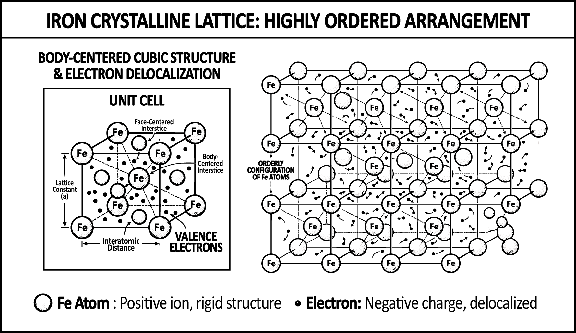
Enormous amounts of energy are spent mining ore, stripping away oxygen, and forcing atoms into rigid, crystalline lattices. These are orderly, conductive, and useful - but they are not stable. They exist in opposition to entropy.
Corrosion, therefore, is not a defect in material.
It is the cost of borrowed order.
The same shared electrons that give metals their strength and conductivity also make them vulnerable. Those electrons are mobile. They are exposed. And once a path exists for them to leave, they will.
In the preceding chapter, we introduced destructive oxidation: electron theft from a structure that needed those electrons to remain useful. When that theft occurs on a metal surface, and when the system provides an anodic site, a cathodic reaction, an ionic pathway, and an electrical connection, the corrosion cell is complete.
At that point, corrosion is no longer a vague possibility. A corrosion current can flow.
What remains uncertain is where, how fast, and how violently it will localize.
That uncertainty - localization, acceleration, and control - is explained by a battery.
| CONCEPT LOCK Corrosion is not a defect in material. It is the cost of borrowed order. Metal exists in a high-energy state. Corrosion returns it to equilibrium. The question is not whether corrosion will occur, but where, how fast, and how violently it will localize. |
|---|
The Corrosion Cell
The corrosion cell is nature’s entropic battery.
It begins with a thermodynamic imbalance.
In the previous chapter, we explored how oxidants exert their reduction potential until they find a surface willing to give up electrons. For now, we will limit our focus to the role of oxygen’s potential to snatch up electrons. O₂ exists as a stable covalent molecule, but its high electronegativity and favorable reduction thermodynamics make it an exceptionally strong electron sink.
Metals exist at a higher energy state than they’d prefer, refined into a thermodynamically unstable crystalline structure. Within the lattice, electrons are delocalized from their respective atoms, which provides glue for the structure. It also provides an easy target for oxygen.
This is the first step in forming a corrosion cell: a mismatch of energy.
The difference between these states is voltage – the electromotive force that compels electrons to move. When this voltage is paired with a continuous path for electrons and ions, chemistry gives way to electricity and a closed circuit forms.
Once this circuit exists, corrosion is no longer a chemical reaction happening to the metal. It is an electrical current flowing through it.
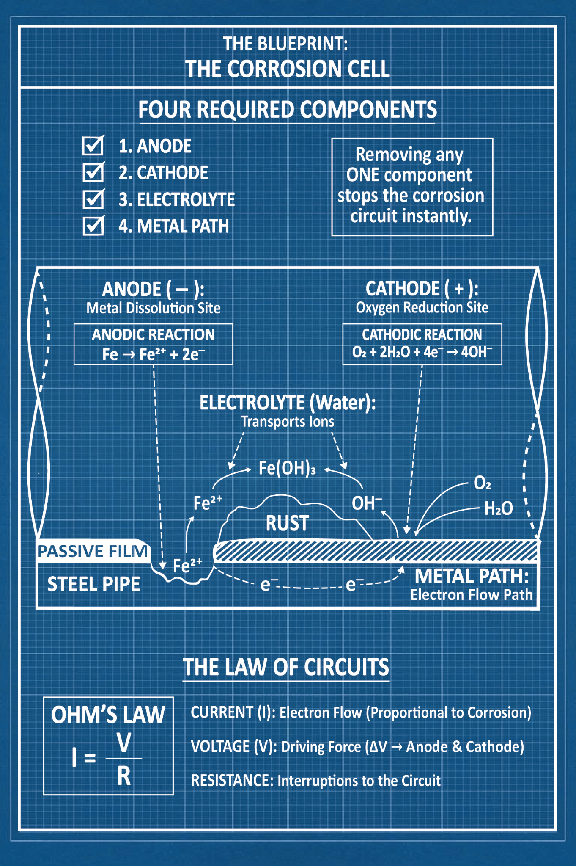
Like any battery, the corrosion cell requires four components:
The Anode: Lower Reduction Potential → Site of oxidation
The Cathode: Higher Reduction Potential → Site of reduction
The Electrolyte: Allows dissolved ions to move, completing half of the circuit
The Metal Path: Allows electrons to move, completing the other half of the circuit
The Anode: Where Metal Leaves
At the anode, metal atoms lose electrons and enter solution as ions:
Fe → Fe²⁺ + 2e⁻
Cu → Cu²⁺ + 2e⁻
This is where metal is lost.
This is where pits begin.
A neutral atom becomes a charged ion, is ejected from the lattice, and dissolves into the surrounding water. It generally begins at a minor defect in the surface of the metal, a microscopic imperfection that leaves the area especially vulnerable - grain boundaries, inclusions, or physical scratches.
Once corrosion starts, the metal does not “thin” evenly. It departs atom by atom, wherever conditions make departure easiest.
The Cathode: Where Electrons Go
Electrons released at the anode do not vanish. They must be consumed elsewhere.
That consumption commonly occurs through oxygen reduction:
O₂ + 2H₂O + 4e⁻ → 4OH⁻
In acidic systems, hydrogen ions can also participate in the cathodic reaction:
2H+ + 2e⁻ → H2
These reactions do not remove metal directly. They provide the electromotive force for metal to jump ship.
By accepting electrons, oxygen and hydrogen allow metal dissolution to continue. This is why a continuous supply of oxygen – or any oxidizer – is so dangerous. By consuming electrons, they allow anodic metal dissolution to continue uninterrupted.
The Electrolyte: One Half of the Circuit
Water acts as an electrolyte by providing a pathway for ions to move.
Charged particles are formed in both the anodic and cathodic reactions. Water allows iron and copper ions to migrate away from the anode, and hydroxide to disperse from the cathode. By allowing these oppositely charged corrosion by-products to move freely, the corrosion current continues to flow.
Without an electrolyte to allow this migration, these charged particles would accumulate at the surface, creating electrical resistance. When the charges are not able to move freely and balance, corrosion comes to a halt. This is why corrosion of dry metals largely comes to a halt.
The Metal Path: The Other Half of the Circuit
Metal allows the freed electrons to move.
When the metal surface is oxidized, the metal ions dissolve into water, while the electrons are transported through the metal to the cathode. The free electrons are consumed in the cathodic reaction, removing them from the metal.
This is why corrosion is not confined to the point of attack. So long as they are connected by an electrolyte, anodic and cathodic sites can be separated over a distance. The metal becomes a wire. The electrolyte distributes the charged ions. Oxygen provides the demand.
The Completed Circuit
When all four elements of the corrosion cell are present, the circuit is energized - and chemistry leaves a record.
At the anode, metal atoms enter solution as positively charged ions.
At the cathode, oxygen reduction generates hydroxide ions.
These charged particles diffuse through the electrolyte, but they don’t stay independent for long.
Near the metal surface of mild steel, ferrous ions (Fe²⁺) encounter hydroxide (OH⁻), and the two combine:
Fe²⁺ + 2OH⁻ → Fe(OH)₂
This reaction does not occur uniformly throughout the water. It occurs at the interface, where ions are being produced and consumed by the circuit itself. The result is ferrous hydroxide - a corrosion byproduct that forms in intimate contact with the metal surface.
As corrosion continues, more ferrous hydroxide accumulates at or near the surface. In the presence of oxygen, it is further oxidized into more stable iron oxides and oxyhydroxides - the familiar red-brown corrosion byproducts we call rust. These compounds adhere loosely or tightly depending on conditions, forming films, tubercles, or deposits that partially cover the metal.
The appearance of corrosion products marks more than material loss.
It marks a completed electrical loop.
Electrons have moved through the metal.
Ions have moved through the water.
Charge has been balanced.
Energy has been released.
Corrosion is not simply metal disappearing into water. It is metal reorganizing itself into a lower-energy form - guided, constrained, and made visible by the completed circuit.
| CONCEPT LOCK Corrosion is not simply metal disappearing into water. It is an electrical circuit: anode, cathode, electrolyte, and metallic path. Remove any one component and the circuit breaks. Leave all four intact and a corrosion current can flow. |
|---|
Passivation: Metal’s Brief Defense
Left to corrosion, a steel surface should not last long in open water.
And yet, many metals survive for years - sometimes decades - without catastrophic loss. They do so not because corrosion has stopped, but because it has slowed.
This slowing is the result of passivation.
It is not immunity from corrosion.
It is more like a ceasefire.
Passivation occurs naturally with most metals, resulting from the corrosion process itself. As the oxidation reaction at the anode releases metal into solution, those ions combine with anions in solution to form thin surface films at the metal-water interface.
These films do not eliminate anodic or cathodic reactions, but they increase resistance by restricting electron transfer, ion migration, and oxidant access at the metal surface. They make it harder for the circuit to be maintained.
Mild Steel
Carbon steel forms a loose, porous oxide layer composed primarily of iron oxides. This film offers limited resistance to electron transfer and oxygen diffusion. It slows corrosion, but does not prevent it.
The film is patchy. It is easily disturbed. And once breached, corrosion resumes immediately at the exposed site.
Mild steel survives not because its passive film is robust, but because operating conditions often remain just stable enough to avoid repeatedly stripping it away.
Copper
Copper behaves differently.
As copper ions react with oxygen and carbonate species, they form a dense, adherent patina. Unlike rust, this patina is often protective. It limits further electron transfer and shields the underlying metal.
This is why copper pipes darken instead of dissolving - and why the Statue of Liberty is enshrined in green armor, rather than dissolving.
Stainless Steel
Stainless steel relies on precision.
Chromium in the alloy forms an exceptionally thin oxide film - only atoms thick - but remarkably tenacious. When damaged, it reforms almost instantly, as a protective chromium oxide layer. This self-healing film is what allows stainless steel to survive environments that would rapidly destroy carbon steel. But it does not mean that stainless steel is always the best choice.
The self-healing capacity can be severely limited by two constraints: low oxygen (anaerobic) environments interfere with repassivation, and chloride-rich environments make localized attack more likely to occur.
Galvanized Steel
Galvanized steel avoids reliance on iron’s weak defenses entirely.
Instead, it coats steel with zinc - a less noble metal that willingly corrodes first. Zinc sacrifices itself, supplying electrons and satisfying cathodic demand before iron ever needs to participate.
As long as zinc remains, the steel beneath is spared. When the zinc is gone, the truce ends.
Breaking the Ceasefire
In most situations, passivation is nothing more than a fragile truce.
Passivation is effective when it is able to shield the vulnerable anodic sites from the corrosive forces of water. Any condition that destabilizes the passive film - chemically, mechanically, or biologically - reveals these localized weaknesses.
Given that the conditions for corrosion still exist, corrosion will return to these sites with a vengeance. Oxidation will concentrate where resistance is lowest, and voltage is highest.
This is why corrosion rarely looks fair: it feeds on itself.
It’s also why we need to know what exactly is breaking the ceasefire of passivation.
| CONCEPT LOCK Passivation is not immunity. It is a ceasefire. The passive film increases resistance but does not eliminate the circuit. Any condition that destabilizes the film restarts the attack. |
|---|
Film Saboteurs
Film saboteurs break the truce.
They are not the primary cause of corrosion, but they determine where corrosion concentrates and how fast it becomes destructive. By disrupting passive films, they expose reactive metal beneath and allow dissolved metal complexes to be carried into the bulk water - lost for good.
This is how uniform corrosion becomes pitting.
And pitting is how systems fail quickly.
Even in otherwise stable systems, a small number of saboteurs can dominate corrosion behavior. Four deserve our utmost attention.
Mechanical Disruption: Flow and Erosion
As water velocity increases, shear forces at the metal surface rise. Turbulence - caused by abrupt changes in direction, diameter, or pressure - amplifies those forces and scours away protective films.
This is why corrosion appears first at elbows, tees, pump impellers, control valves, and heat exchanger inlets. The film is stripped away, and anodic sites are exposed faster than they can re-passivate.
We rarely control system geometry or fluid dynamics. But understanding where mechanical disruption occurs explains why corrosion localizes - and where it will reappear after repair.
Chemical Dissolution: Acids
Passive films are stable only within a narrow pH window.
As pH drops, hydrogen ions protonate the metal oxide layer, converting protective films back into soluble species. A film that took weeks or months to form can dissolve in minutes under acidic conditions.
This is why transient acid exposure is so dangerous. The damage persists long after pH is restored. Acids also increase corrosion potential by accelerating anodic reactions, compounding the loss.
The Film Breaker: Chloride
Chloride ions are small, mobile, and relentless.
They penetrate oxide films and concentrate at the metal surface, where they form soluble metal–chloride complexes. These complexes carry metal away from the surface, preventing repassivation.
Chloride does not remove the entire film.
It creates weak points - and then exploits them.
The result is not uniform thinning, but deep, localized pitting.
The Double Agent: Sulfate
Sulfate ions are less aggressive on their own, but more dangerous in combination.
Chemically, they can destabilize passive films through complex formation. Biologically, they serve as electron acceptors for sulfate-reducing bacteria, which convert sulfate into sulfide and hydrogen sulfide - both highly corrosive species.
Sulfate is therefore a double agent: chemically disruptive, and biologically enabling under the right conditions. Systems with stagnant zones, deposits, or low-flow regions provide ideal territory for both mechanisms to operate.
Quantifying the Sabotage
Film saboteurs weaken the defenses.
Though they often pass unnoticed, each one places additional stress on the passive film protecting the metal. Given enough time, they will expose anodic sites to the relentless process of oxidation.
The Larson-Skold Index (LS) quantifies this sabotage – and the Engineering Notes show you how to calculate it. But saboteurs do more than restart corrosion. By stripping resistance, concentrating oxidants, or accelerating electron transfer, they increase the voltage driving it. When this happens, the corrosion cell does not merely persist.
It intensifies.
Supercharging the Corrosion Cell
The corrosion cell is governed by the same rule as any electrical circuit.
Ohm’s Law:
Current = VoltageResistance
When the passive film fails, both terms move in the wrong direction. Resistance drops because the protective barrier is gone. Voltage increases because the exposed bare metal has a much lower reduction potential than the surrounding passivated surface.
Current density increases.
Metal loss accelerates.
Damage localizes.
Once this imbalance forms, the corrosion cell begins to reinforce itself. The environment at the anode diverges from the bulk water. Acidity rises. Chloride concentrates. Oxygen remains more available outside the pit than inside it, strengthening the oxygen differential. Repassivation becomes unlikely. What began as a surface disturbance becomes a feedback loop.
This is the electrochemical basis of pitting corrosion.
| CONCEPT LOCK When the passive film fails, corrosion reorganizes. Voltage increases. Resistance decreases. Current concentrates. This is the electrochemical basis of pitting - and pitting is how systems fail. |
|---|
Oxygen Differential Corrosion
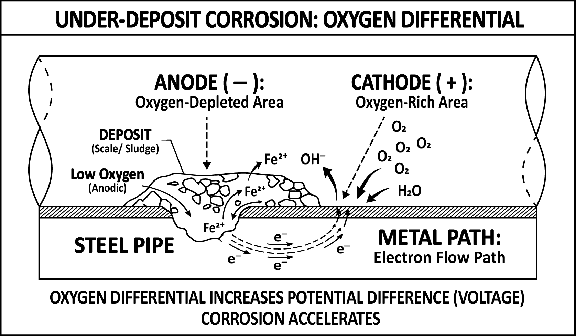
Once a pit forms, the environment inside becomes starved of oxygen, while the surrounding metal remains well-aerated. This sets up an oxygen differential cell: high oxygen at the rim (the cathode), low oxygen at the pit base (the anode).
The Result: A powerful electrochemical potential forms. The large cathode (surface) drives intense dissolution at the tiny anode (pit). Chloride ions migrate into the pit to balance the charge, creating an acidic, salt-rich soup that drills through metal at terrifying speeds.
Under-Deposit Corrosion
Deposition in water systems can come from corrosion by-products, scale, biofouling, and suspended solids. They’re all lumped in by the rather encompassing term “deposition,” which indicates that the surface of the metal is covered by a foreign material. This creates a localized oxygen-depleted region, which sets up the conditions for oxygen differential corrosion.
Cooling towers are prime victims. Dirt, sludge, and biofilm act just like a pit. The metal under the deposit is starved of oxygen (Anodic), while the clean metal nearby is oxygen-rich (Cathodic).
The Result: Beneath these innocuous-looking deposits, corrosion accelerates in the shadows. The process is quiet, persistent, and perfectly designed to escape detection until it’s too late.
Microbiologically Influenced Corrosion
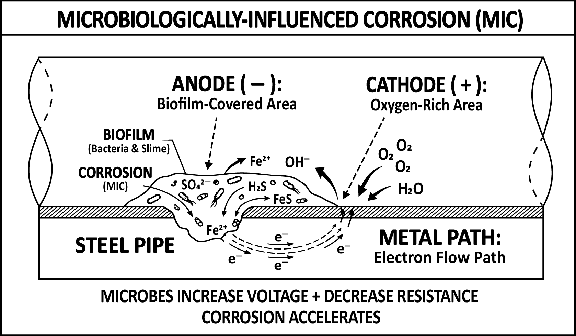
When systems contain high concentrations of microbiological agents (bacteria, fungi, algae), they are particularly susceptible to corrosion. Not only do these organisms bond to metal surfaces and create rigid biofilms that aid in under-deposit corrosion, but they create their own supercharger.
Certain bacteria, like sulfate-reducing bacteria (SRB) and iron-oxidizing bacteria, are particularly damaging. They alter local chemistry as part of their metabolism, producing sulfides, acids, and other byproducts that aggressively destabilize metal surfaces.
The result: These organisms effectively create their own built-in supercharger: a living anode factory. This is under-deposit corrosion on steroids - localized, aggressive, and often accompanied by a telltale sulfur smell.
Galvanic Corrosion
Galvanic corrosion occurs without subtlety.
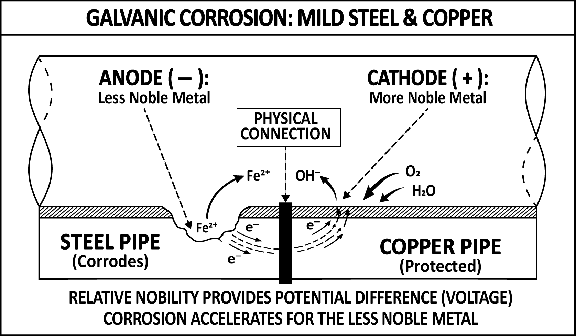
It happens when two dissimilar metals are placed in electrical contact and immersed in an electrolyte. Metals differ in their willingness to oxidize, which is referred to as their nobility. The nobility of different metals can be compared by their relative positions in the galvanic series.
Galvanic corrosion increases voltage by electrically coupling two metals with different nobility. The more noble metal exerts an electric potential, leading to corrosion of the less noble metal.
The further apart the metals are on the Galvanic Series, the higher the voltage and the faster the anode dissolves. This is why we use dielectric unions - insulating barriers that break the electrical path and stop the battery. Mixed metallurgies in systems sometimes makes this challenging.
The Result: Galvanic corrosion always targets the less noble metal. It will proceed until there is no more anodic surface available, which often results in rapid, catastrophic failure of the anodic component. The severity of attack depends not just on how far apart the metals sit on the galvanic series, but on the ratio of their surface areas: small anode/ big cathode being far more dangerous than the reverse.
From Supercharging to Suppression
Up to this point, we have watched corrosion become efficient.
Passive films fail. Resistance drops. Voltage concentrates. Current focuses into smaller and smaller regions of metal until damage accelerates and localizes. Whether through oxygen differentials, deposits, biology, or metallurgy, the story has been the same: corrosion thrives when its circuit is allowed to organize itself efficiently.
Protection begins by doing the opposite.
Corrosion Protection: Interrupting the Circuit
Corrosion cannot be eliminated.
But it can be disrupted.
Once corrosion is understood as an electrical circuit, protection becomes a matter of strategy. By interfering with any one part of the circuit, we can slow the inevitable march of entropy to a crawl.
-
Anode
-
Cathode
-
Electrolyte
-
Metallic path
In practical systems, two of these are fixed. Water must remain. Metal must remain. That leaves two levers we can realistically pull: the anodic reaction and the cathodic reaction.
Every corrosion control strategy - chemical, mechanical, or material - works by targeting these parts of the circuit. Some raise resistance. Some remove reactants. Some prevent the circuit from assembling at all.
Cathodic Control: Increasing Resistance
At the cathode, electrons are consumed. If that consumption can be slowed, the entire circuit weakens.
In most water systems, cathodic reactions generate hydroxide ions, raising pH at the metal surface:
O₂ + 2H₂O + 4e⁻ → 4OH⁻
This localized increase in pH shifts carbonate equilibria and creates conditions favorable for calcium carbonate precipitation directly at the surface. When properly controlled, this precipitation forms a whisper-thin, discontinuous film that interferes with oxygen access and electron transfer.
This film is not permanent. It is fugitive.
It dissolves back into the bulk water when conditions change – and reforms when conditions return. Its strength lies not in durability, but in equilibrium.
Waters with sufficient calcium and alkalinity can support this defense naturally. Waters that lack these building blocks cannot. This is why ultra-soft, low-alkalinity waters are often corrosive: the cathode has nothing to hide behind.
The Langelier Saturation Index (LSI) and Ryznar Stability Index (RSI) can be used to evaluate whether a given water chemistry has the potential to support this fugitive calcium-carbonate layer. These indices describe the thermodynamic tendency of water to precipitate or dissolve calcium carbonate under bulk conditions.
They do not predict corrosion.
Local conditions at the metal surface - oxygen availability, flow, deposits, aggressive anions, and microbiology - ultimately determine how fast corrosion occurs. LSI and RSI simply tell us whether calcium carbonate has the opportunity to participate in raising cathodic resistance at all.
In practice, we don’t rely on calcium carbonate alone. Phosphonates like HPA and PBTC are used to stabilize and refine this fugitive film in two ways:
-
Threshold inhibition: At very low concentrations, phosphonates adsorb onto calcium carbonate nuclei and distort crystal growth. This helps to prevent uncontrolled scaling, and allow only a highly dispersed, nanocrystalline film to form at the surface.
-
Film refinement and stabilization: Certain phosphonates do more than suppress bulk scale. By adsorbing at the metal–water interface and interacting with calcium ions, they can influence how carbonate deposits form and adhere - favoring thin, dispersed, and less insulating boundary layers rather than thick, crystalline scale.
The goal is a chemically enhanced, self-renewing boundary layer: thin enough to avoid heat-transfer penalties, dynamic enough to reform if disrupted, and robust enough to suppress oxygen-driven cathodic corrosion.
Cathodic control does not stop corrosion.
It raises resistance, which makes the circuit harder to run.
Anodic Protection: Locking the Lattice
At the anode, metal atoms leave the lattice.
Fe → Fe²⁺ + 2e⁻
Anodic control aims to prevent that departure.
Anodic inhibitors work by strengthening or enforcing passive films that lock metal atoms in place. When effective, they make electron loss energetically unfavorable and suppress metal dissolution at its source.
Nitrite is the classic example. It promotes a stable iron oxide film that suppresses anodic dissolution in closed systems, provided concentration and pH are maintained. The result is passivation on steroids, resisting further oxidation by immobilizing the surface lattice. When maintained within proper limits, nitrite provides excellent corrosion protection with minimal scaling concerns.
But anodic protection carries inherent danger.
Partial coverage concentrates corrosion. If inhibitor levels fall too low, unprotected sites become intense anodes surrounded by protected cathodic surfaces. The result is rapid, localized attack.
Anodic control works best where chemistry is stable, monitoring is reliable, and the system can be kept within narrow limits.
Removing the Oxidizer: Starving the Circuit
Corrosion requires an electron acceptor.
In most industrial water systems, that acceptor is oxygen.
In systems that are closed to the atmosphere - like boilers - oxygen can be removed almost entirely. This is achieved mechanically through deaeration, or chemically through oxygen scavengers such as sulfite, bisulfite, or organic reducing agents. Even trace oxygen concentrations can sustain corrosion, which is why both mechanical and chemical methods are commonly used together.
Though often discussed as boiler-specific practices, oxygen control is fundamentally electrochemical: fewer oxidizers mean fewer cathodic reactions. This does not protect the metal directly, but it deprives the cathode of its preferred reaction. Without oxygen, the circuit weakens regardless of surface chemistry.
Eliminating oxygen is one of the most effective ways to suppress the circuit entirely, but it only works in closed systems. In systems that are open to the atmosphere - like cooling towers - oxygen is continuously replenished by the surrounding air.
Film-Forming Inhibitors: Preventing the Circuit from Assembling
Some inhibitors do not slow reactions - they prevent contact.
Azoles are used specifically to control copper corrosion. These organic molecules chemically bond to the copper surface, forming hydrophobic films that block water access and suppress both anodic and cathodic reactions.
Filming Amines or Film-Forming Amines operate similarly in boilers and condensate systems. They bond to the metal surface, creating hydrophobic barriers that protect against oxygen, carbonic acid, and iron transport.
Choosing the Lever
None of these corrosion control strategies are competing philosophies.
They are tools.
Some systems favor dynamic, self-renewing defenses. Others require rigid, enforced passivity. Most real systems rely on a balance - nudging both reactions just enough to keep the circuit from organizing itself efficiently.
The mistake is not choosing the “wrong” inhibitor.
The mistake is forgetting which part of the circuit you are touching.
Corrosion control is not about chemistry in isolation.
It is about where electrons are allowed to move - and where they are not.
Every inhibitor, every adjustment, every material choice ultimately answers the same question:
How hard are we making it for the circuit to run?
The Two Ends of Thermodynamics
Corrosion describes what happens when metal yields to water.
Metal exists in a restless, high-energy state. Oxidation offers a path downhill, and water provides the conditions for that path to open. Once the circuit is complete, electron transfer is rewarded, the metal begins to dissolve, and corrosion becomes not just possible, but thermodynamically favored. It is entropy at work.
But this is only one half of the story.
Thermodynamics does not only tear structures apart. Under the right conditions, it builds them.
In corrosion, atoms leave a solid lattice and the structure is destroyed.
In scale, dissolved ions leave solution and assemble into a new solid.
Both processes are driven by the same search for lower-energy arrangements. One dismantles order. The other creates it.
That is the tension at the heart of water treatment.
The conditions that suppress corrosion often encourage scale. Waters capable of forming protective films may also be poised to deposit stone. Waters that resist scale may leave metal exposed and vulnerable. The water treater lives between those outcomes, managing one without inviting the other.
Up to this point, we have followed electrons as they escape metal.
In the next chapter, we will follow ions as they decide whether to remain dissolved or assemble into stone.
⟵ 07 Corrosion · Contents · 07 Corrosion (Engineering Notes) ⟶