⟵ 09 Microbiology · Contents · 09 Microbiology (Engineering Notes) ⟶
Microbiology: Narrative
The One Problem Chemistry Cannot Solve Alone
Every problem in water treatment eventually comes down to control.
Scale forms when chemistry crosses a threshold. Corrosion accelerates when electrochemical balance is lost. Suspended solids foul systems when flow and filtration fall out of alignment.
In every one of those cases, the solution is conceptually straightforward: change the conditions, and the problem slows or stops.
Microbiology is different.
Biological fouling does not simply respond to conditions – it adapts to pressure. When chemistry becomes hostile, biology does not politely disappear. Given water, energy, and a surface, living systems do something no other failure mechanism in this book can do:
They build shelter.
If you have ever felt the film on your teeth, scrubbed a shower, cleaned a pet’s water bowl, or fought the slime inside a water bottle, you have encountered that structure firsthand. What makes it so frustrating is not just that microbes are present. It is that they have built infrastructure between themselves and the surface we are trying to reach.
Once that shelter exists, chemistry no longer acts where we think it does. Biocides do not reach the organisms we intend to kill. Electrochemical reactions no longer occur in the bulk environment we measure. From that moment on, the familiar rules of water treatment begin to fail – not because the chemistry is wrong, but because we have lost access.
Biology has won the race to the surface.
The Advantage of Being Alive
A single microbial cell is already a remarkable system.
It takes in nutrients, extracts energy, repairs damage, and makes copies of itself. It senses its surroundings. It reallocates resources in response to stress. When conditions worsen, it does not simply disappear. It slows down, hardens, and waits.
Under favorable conditions, a single cell can become millions in less than a day – then billions soon after. Not because bacteria were added to the system, but because the system was habitable. And water makes almost every system habitable.
The Hydrogen-Bond Network dissolves and transports the nutrients that cells need to grow. It buffers temperature into a range that biology can tolerate. It provides the medium through which chemical signals travel, waste is dispersed, and energy gradients persist. From the perspective of a microorganism, many industrial water systems are not hostile environments. They are warm, nutrient-rich incubators.
But there is a limit to how much a free-floating cell can withstand.
In open water, planktonic cells are vulnerable. Flow strips them away. Oxidants attack them. Starvation limits growth. Left in this state, most microbes would never gain a lasting foothold.
Biofilm is the solution to that problem.
It is the structure that turns vulnerable cells into a protected surface community–and it is the reason microbiological control is fundamentally different from every other discipline in this book.
| CONCEPT LOCK Scale stops when conditions change. Corrosion slows when circuits are interrupted. Biology adapts. It responds to pressure, reorganizes under stress, and recovers from damage. A single cell is a factory. A biofilm is infrastructure. This is why biological control requires fundamentally different thinking. |
|---|
The Infrastructure of Biofilm
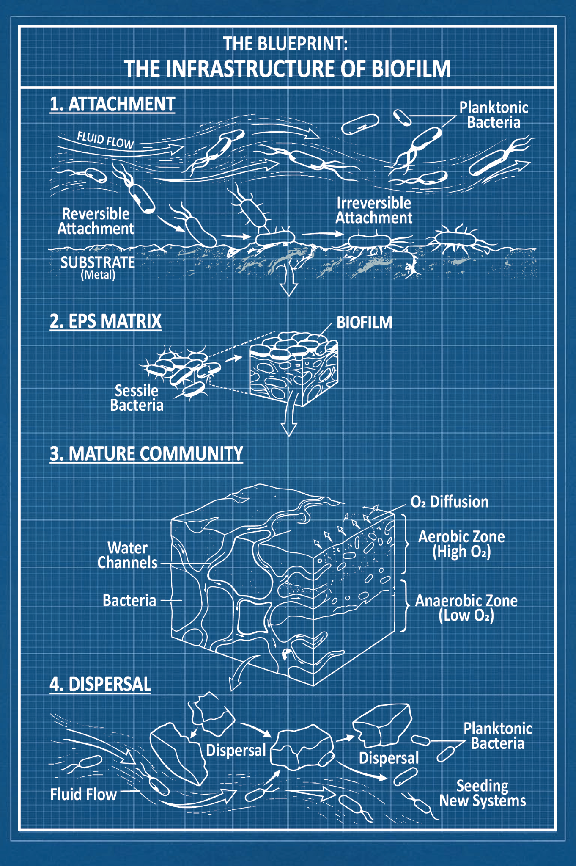
Microbial cells are inherently capable of attaching to surfaces.
That ability helps them scavenge nutrients in soil, colonize aquatic systems, and establish themselves wherever water lingers. Built into their biology is the ability to secrete sticky extracellular polymeric substances (EPS), allowing them to grip surfaces, resist removal, and begin building shelter.
Attachment
The biofilm lifecycle begins with attachment. A planktonic cell drifting through water does not arrive at a bare surface alone. Most wetted surfaces are already coated with a thin conditioning film of organic material, corrosion byproducts, or deposits. That film changes the chemistry of the interface and gives cells something to grab.
The initial attachment is weak, reversible, and easily disrupted by flow. Most cells that contact a surface are swept away.
But some remain. They find a low-flow zone, a surface irregularity, or a deposit that breaks the boundary layer. Once attachment becomes more permanent, EPS production increases. The floating cell becomes an attached, sessile bacterium, and the first layer of protection begins to form.
This is the moment everything changes.
The EPS Matrix
EPS is the biofilm’s building material, and it deserves its own examination because it is what makes biofilms so difficult to control.
EPS is not a cell wall. It is an external scaffold – a gel-like matrix that surrounds and connects cells within the community. From the outside, EPS looks and feels like slime. From the inside, it is infrastructure.
It concentrates nutrients from the surrounding water. It binds metals. It buffers pH. And critically, it slows the diffusion of oxidants and biocides – giving the outer layers time to absorb a chemical assault before it reaches the organisms deeper in the structure.
The biofilm is not a coating. It is a barrier to access.
This is not accidental. It is selection. Structures that absorb stress persist. Structures that fail disappear. Over time, what remains is the version best suited to survive.
The Mature Community
Once a biofilm establishes beyond its initial attachment, it stops behaving as a collection of individuals and begins behaving as a system. Cells communicate chemically through quorum sensing – a signaling process that allows the population to coordinate behavior based on density. Growth becomes structured. Resources are shared. Defense becomes collective.
A mature biofilm is a layered city built at the scale of microns. Channels form to move nutrients and waste. Gradients develop across the structure – oxygen may be plentiful near the surface and depleted at the base; pH may remain near neutral at the top while drifting acidic at the metal interface. Different species occupy different niches, each exploiting the environment created by the others.
From the outside, the pipe surface looks unchanged.
Inside, conditions bear no resemblance to the bulk water.
As the community grows, fragments break free – sheared off by flow, released by quorum signals, or dislodged during load changes. These fragments carry living cells already primed for attachment, already producing EPS. They are not starting from scratch the way a lone planktonic cell would. When they land on a clean surface downstream, colonization is faster, attachment is stronger, and the new community inherits the resilience of the one that produced it. A single established biofilm does not represent a single problem. It represents a source of future problems everywhere the water travels.
Why This Matters for Water Treatment
The biofilm changes the rules of engagement.
Oxygen may be abundant in the pipe, but depleted at the metal surface beneath the film. pH may be neutral in the bulk water, but acidic within the structure. Oxidants may be present in the water column, but consumed before they penetrate deeply enough to matter.
The water analysis still looks acceptable. The surface environment does not.
This is why biological problems so often surprise operators. The system is being judged by conditions that no longer apply where the damage is occurring. Every test we run measures the bulk water. The biofilm operates in a private chemical environment that our tests cannot see.
And once a mature biofilm has developed, the entire system is at greater risk.
| CONCEPT LOCK Biofilms begin with attachment to surfaces in low-flow zones. EPS provides structure, diffusion resistance, and chemical protection. Mature biofilms create internal environments that diverge completely from bulk water. They also seed other parts of the system. The water analysis may look acceptable. The surface environment may not. |
|---|
When Biology Meets Metal
Microbiologically influenced corrosion (MIC) is not a different kind of corrosion. It is corrosion operating under conditions that biology creates.
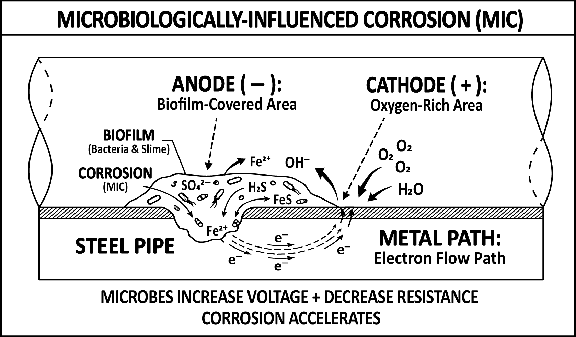
In the Corrosion chapter, we explored the electrochemical cell: an anode that dissolves, a cathode that accepts electrons, an electrolyte that connects them, and a metallic path that completes the circuit. MIC does not replace this mechanism. It supercharges the local conditions that make the mechanism aggressive.
The Local Environment
Inside a biofilm attached to a metal surface, oxygen availability changes rapidly with depth. Near the outer surface of the film, oxygen may be plentiful. At the metal interface, microbial respiration can consume it entirely. The covered metal becomes anodic – the same oxygen differential cell we explored in the Corrosion chapter, but created and maintained by living organisms rather than by a passive deposit.
pH drifts downward as metabolic acids accumulate. Redox potential collapses. Re-passivation of the metal surface becomes unlikely because the biofilm continuously regenerates the conditions that destabilize protective films.
From the perspective of the corrosion cell, this is ideal. Anodic and cathodic regions separate cleanly. Localized attack accelerates while the surrounding system appears stable.
Active Participants
Some organisms influence corrosion passively, simply by creating shelter and consuming oxygen. Others participate more directly.
Sulfate-reducing bacteria (SRB) use sulfate as an electron acceptor in the absence of oxygen, producing hydrogen sulfide as a metabolic byproduct. Hydrogen sulfide destabilizes passive iron films and reacts directly with the metal surface. The characteristic black deposits and sulfide odor beneath tubercles are the signature of SRB activity.
Iron-related bacteria (IRB) can contribute to deposit formation, alter local redox conditions, and support the formation of surface environments where corrosion can localize and persist. Acid-producing bacteria (APB) lower pH at the metal surface, increasing the anodic reaction rate.
In each case, biology does not replace electrochemistry. It feeds it. The corrosion cell still operates by electron flow. Biology supplies favorable conditions – and does so continuously, day and night, as long as the community persists.
Why MIC Is Persistent
Chemical upsets pass. Flow changes. Temperatures fluctuate. But a biofilm-associated corrosion community recovers quickly from partial disruption. It repopulates protected niches, re-establishes gradients, and resumes metabolic activity as soon as conditions allow.
MIC does not require catastrophic chemistry or extreme operating conditions. It requires time, a surface, and shelter from the treatment program. It emerges where surfaces remain wet, where flow is intermittent or uneven, where deposits restrict chemical access, and where monitoring focuses exclusively on bulk water.
MIC is not a microbiology problem.
It is a design, operation, and monitoring problem.
| CONCEPT LOCK MIC is corrosion operating under conditions that biology creates – not a separate mechanism. Biofilms create oxygen differentials, pH gradients, and metabolic byproducts that accelerate the corrosion cell. SRB, IRB, and APB are active electrochemical participants. MIC persists because the biofilm continuously regenerates the conditions that drive it. |
|---|
Biocides: The Access Problem
Once biology becomes established, the instinctive response is simple: kill it.
Biocides exist for exactly this reason. They damage cell membranes, denature proteins, disrupt metabolic pathways, and halt reproduction. Used correctly, they are powerful tools. Used alone against established biofilms, they are often disappointing.
The problem is not potency.
The problem is access.
Oxidizing Biocides
Chlorine and bromine are the most common oxidizing biocides used in industrial water treatment, and both operate by the same blunt force: oxidation. They steal electrons indiscriminately, damaging cell membranes, denaturing proteins, and disrupting the metabolic machinery that keeps organisms alive. This makes them excellent at suppressing planktonic populations and limiting new colonization.
Their indiscriminate strength, however, creates two serious constraints.
First: oxidants attack unintended targets. They follow the path of electron availability, which isn’t limited to microbes. Oxidation also attacks metals, elastomers, and inhibitors, which can carry severe consequences.
Second: established biofilms create an access problem**.** The EPS matrix is not a passive coating; it is reactive infrastructure. Oxidants are largely consumed by the outer layers of the film – often before lethal concentrations reach the inner community. The result can look like success in the water column followed by rebound on surfaces: the messengers die, the city survives. This is usually not a failure of potency. It is a failure of access to the surfaces that matter.
Chlorine adds a third constraint: speciation. Free chlorine exists as hypochlorous acid (HOCl) and hypochlorite ion (OCl⁻), governed by the pH of solution. HOCl is the far more effective biocidal form, but its relative concentration falls sharply as pH rises. At a pH of 8.5, only a small fraction of the free chlorine residual remains as HOCl, drastically reducing the instantaneous lethality of chlorine in alkaline cooling towers. Bromine retains a substantially higher fraction of its active form at elevated pH, which is why it is commonly used in these systems.1 Chlorine programs can still be effective, but they become much more dependent on contact time, feed strategy, and residual persistence.
Non-Oxidizing Biocides
Non-oxidizing biocides target specific biological functions: cell division, enzyme activity, membrane integrity. They can penetrate EPS more effectively than oxidants because they are not consumed by reaction with the matrix as readily. Used properly, they suppress growth in locations that oxidizing biocides cannot reach.
But specificity cuts both ways. Cells under stress slow their metabolism. Dormant cells reduce uptake. Biofilm-associated organisms may simply wait out the exposure, resuming activity once concentrations fall. What appears to be resistance is often patience.
Selection
Repeated biocide exposure does not just reduce populations. It selects.
Organisms that survive treatment pass along traits that favor tolerance: thicker EPS production, slower growth, altered metabolic pathways, dormancy responses. Over time, the community shifts toward organisms better suited to the chemical environment we create.
The system does not become sterile. It becomes adapted.
This is why alternating between oxidizing and non-oxidizing biocides - attacking different targets with different mechanisms – is more effective than escalating a single approach. Rotation disrupts the selection pressure that sustained exposure creates.
What Biocides Are Good At
Biocides are maintenance tools. They suppress planktonic growth, limit new colonization, control population density, and reduce the rate at which new biofilm establishes. They reduce risk. They buy time.
What they do not reliably do, on their own, is dismantle established biological infrastructure.
Effective biological control requires coordination: mechanical removal to strip deposits, dispersants to expose sheltered surfaces, flow management to eliminate stagnant zones, and strategic biocide use to suppress regrowth after the shelter has been removed. Biocides work best when they are not asked to do everything.
Killing microbes is easy. Removing their shelter is not.
As long as biological infrastructure remains intact, biocides behave like siege weapons firing at a fortified city – damaging the outskirts while the core survives.
| CONCEPT LOCK The limiting factor for biocides is access, not potency. Oxidizing biocides clear the water column but are consumed by EPS before reaching inner cells. Non-oxidizing biocides penetrate better but face dormancy and selection. Effective control requires mechanical removal + dispersion + flow management + biocide. |
|---|
Heat: The Honest Biocide
Heat does not rely on oxidation potential. It does not depend on uptake. It does not ask a cell to remain metabolically active. At sufficient temperature and exposure time, biology simply cannot survive.
This makes heat the most honest biocide we have.
But it does not make it perfect.
Thermal disinfection works only when heat reaches every surface and remains there long enough to matter. In real systems, that requirement is rarely met uniformly. Biofilms insulate. Dead legs remain cool. Heat dissipates rapidly once flow resumes. The same structural features that protect microbes from chemicals protect them from temperature.
Partial heating does not sterilize a system. It clears the easy territory and leaves behind the protected zones.
A practical rule of thumb is simple: as temperature rises, kill becomes faster – but only where that temperature is actually achieved and maintained. Warm water may stress organisms without eliminating them. Hot water can kill rapidly, but only if it reaches the full system, including sheltered surfaces and stagnant branches.
Heat proves a crucial point:
Biology is not difficult to kill. It is difficult to reach.
As long as shelter remains intact, no biocide – chemical or thermal – will produce lasting control on its own.
| CONCEPT LOCK Heat is the most honest biocide: no pH dependence, no selective chemistry, no reliance on metabolism. But heat must reach every surface and remain there long enough to matter. Biofilms insulate. Dead legs stay cool. Partial heating leaves protected survivors behind. The access problem applies to thermal treatment just as it applies to chemical treatment. |
|---|
Reconnaissance: Monitoring the Unseen
Once biology establishes shelter, direct control becomes difficult. At that point, information matters more than force.
The central problem with biological monitoring in water treatment is that our routine measurements sample the bulk water. Heterotrophic plate counts, ATP assays, dip slides, and culture-based tests all measure planktonic life – cells that have detached, been sheared away, or are reproducing in the water column. These measurements are useful. They tell you whether biological pressure exists, whether treatments are suppressing growth, and whether populations are rising or falling over time.
What they do not reliably tell you is where the real activity lives.
Low counts do not guarantee clean surfaces. A system can show acceptable planktonic results while a mature biofilm persists undisturbed on pipe surfaces, fill media, or dead legs. High counts do not always mean active damage – a temporary bloom after a system upset may look alarming without indicating established fouling.
Bulk measurements are history books, not live feeds.
Surfaces Are Where the Decisions Are Made
Biofilms form on surfaces. Corrosion occurs at surfaces. Heat transfer is lost at surfaces. Pathogens persist at surfaces. And yet surfaces are the hardest part of the system to interrogate.
Coupons, probes, pressure-drop trends, heat-transfer performance, and visual inspection during shutdowns provide indirect evidence. None are perfect. All are partial. Effective reconnaissance relies on patterns rather than single data points: rising biocide demand, increasing differential pressure, drift between chemistry and performance, and rapid rebound after treatment are all signals that biological infrastructure is present and active.
Biology Leaves Fingerprints
Even when hidden, biological systems leave traces. Slime, deposits, odor, discoloration, and localized corrosion patterns often reveal more than lab results. Under-deposit corrosion with black staining points toward sulfate-reducing bacteria. A sulfide odor near a dead leg suggests anaerobic activity. Rapid biocide consumption despite adequate feed rates suggests that chemistry is being consumed by EPS before it reaches organisms.
When corrosion or fouling behaves inconsistently with bulk chemistry, biology should be assumed present until proven otherwise.
The better question is never: “Is biology present?”
The better question is: “Is biology organizing itself faster than we are disrupting it?”
The Human Impact: Legionella
Legionella did not become important because it is unique. It became important because it exposed a truth the industry could no longer ignore.
Legionella does not require obviously dirty water. It does not announce itself with dramatic warning signs. It can thrive in systems that appear to be operating normally.
Legionella prospers under conditions we routinely create: warm temperatures between 77°F and 113°F, intermittent flow, complex plumbing geometries, and biofilms that provide shelter and nutrients. It does not need extreme chemistry or dramatic failure.
It needs time, access to surfaces, and protection from disinfectants. In other words, it needs infrastructure – the same infrastructure every biofilm in this chapter has been building.
Cooling towers, hot water systems, storage tanks, dead legs, and low-use branches provide exactly the environment Legionella prefers. Once established within a biofilm, it benefits from the same advantages all biofilm-associated organisms enjoy: chemical insulation, persistence, and the ability to recover after treatment.
Legionella control fails for the same reason biological control fails elsewhere. Not because we lack disinfectants or regulations. But because we underestimate how effectively biology uses shelter. Chemical disinfectants may suppress planktonic populations while leaving surface communities intact. Thermal treatment may clear portions of a system while missing protected zones. Monitoring may show acceptable results while reservoirs persist out of reach.
Why Legionella Changes the Stakes
Corrosion damages equipment. Scale reduces efficiency. Legionella crosses a line.
It directly impacts people.
More specifically, it often impacts immunocompromised people who never consented to the risks created by system design and operation.
Legionella management cannot be reduced to test-and-treat. It requires understanding how systems create shelter, recognizing when access has been lost, designing for circulation and temperature control, and maintaining constant awareness rather than episodic response.
Legionella is not a failure of chemistry.
It is a failure of systems thinking.
| CONCEPT LOCK Legionella thrives in the same conditions every other biofilm exploits: warm water, shelter, time. Outbreaks are systems failures, not chemistry failures. Legionella management requires design, circulation, temperature control, and continuous awareness. This is where water treatment becomes a public health responsibility. |
|---|
The Closing Truth
Biology in water systems is not an anomaly. It is an outcome.
Given water, surfaces, time, and energy gradients, life will organize itself. It will build shelter. It will persist. And if left unchecked, it will matter in ways that extend beyond pipes and equipment.
This is what happens when organization outpaces control.
Every other threat in this book – scale, corrosion, suspended solids – is governed by physics and chemistry. They obey equations. They respond predictably to changes in temperature, pH, concentration, and flow. Biology obeys these forces too, but it adds a dimension that nothing else in water treatment possesses: the capacity to respond, adapt, and rebuild.
Treating biology as a chemistry problem is why biocide programs disappoint. Treating it as a systems problem – controlling shelter, maintaining access, managing surfaces, and using chemistry as one tool among several – is how we keep it manageable.
It will never disappear. The goal is not eradication. The goal is containment: ensuring that biology organizes itself no faster than we disrupt it, and that the surfaces we need to protect remain accessible to the treatments we apply.
⟵ 09 Microbiology · Contents · 09 Microbiology (Engineering Notes) ⟶
Footnotes
-
The pH dependent equilibrium between hypochlorous acid (HOCl) and hypochlorite ion (OCl-), with a pKa near 7.5 at 25 C, and the parallel bromine equilibrium (HOBr pKa near 8.7). See White’s Handbook of Chlorination and Alternative Disinfectants (Black and Veatch). Confirm the edition and page at time of publication. ↩