⟵ 10 Suspended Solids · Contents · 10 Suspended Solids (Engineering Notes) ⟶
Suspended Solids: Narrative
The Problem with Dirt
Suspended solids rarely headline failures.
Left to their own devices, they are arguably the most boring components in a water system. They don’t have a solubility product. They don’t come with dramatic redox tables or clean equilibrium diagrams. They are just… dirt.
And yet suspended solids are responsible for one of the most frustrating experiences in water treatment:
Perfect chemistry on paper, and a system that still fails.
A little silt does not change pH. A bit of dust does not “consume alkalinity.” Suspended solids are not inherently aggressive. If they stayed suspended forever, they would remain mostly harmless - just particles moving with water.
But they don’t stay suspended.
Given time and the right hydraulics, particles do what gravity has always done: they settle. They collect. They wedge into corners. They accumulate in low-flow zones. And once they stop moving, they stop being suspended solids and become something far more consequential:
Deposits.
Deposits don’t merely “make things dirty.”
They steal access to the surfaces where every important outcome is decided.
Corrosion happens at surfaces.
Biofilms live at surfaces.
Scale grows at surfaces.
Heat transfer is won or lost at surfaces.
As long as those surfaces remain exposed, chemistry can do its job.
Once deposits take over, chemistry begins fighting behind a wall it cannot reliably penetrate.
Suspended solids are boring until they become deposits.
Then they become the amplifier behind nearly every failure mode in this book.
Two Kinds of Cargo
In the Stuff in Water chapter, we drew a fundamental distinction between two kinds of matter in water: Dissolved and suspended.
That distinction matters more here than anywhere else in the book.
Dissolved solids
Dissolved solids have been dismantled at the molecular level. Their crystal lattice has been overcome by hydration energy, and individual ions have disappeared into the Hydrogen-Bond Network. They are invisible. They move wherever the water moves. They are governed by chemistry - equilibrium, solubility, and reaction kinetics.
Suspended solids
Suspended solids have not been dismantled. They are intact particles - sometimes visible, sometimes microscopic - carried mechanically by moving water. Their transport and deposition are governed primarily by physics: flow, turbulence, velocity gradients, and gravity. Chemistry matters once they settle and create micro-environments, but the act of getting them onto the surface is largely mechanical.
This is the essential difference:
Dissolved solids go wherever the water goes.
Suspended solids go wherever the system lets them.
They settle in low-flow zones. They collect on surfaces. They wedge themselves into dead legs, basin corners, tube sheets, and horizontal pipe runs - places where flow slows and gravity wins.
And when that happens, the system stops being a set of pipes and heat exchangers full of water.
It becomes a set of surfaces covered by private chemistry.
Where Suspended Solids Come From
The source depends entirely on the system.
Open Systems
Cooling towers are exposed to the atmosphere by design. Air is drawn across the fill to evaporate water and reject heat. That air carries everything the environment offers: dust, pollen, insects, leaves, construction debris, cotton from nearby trees, and fine particulate from roads, parking lots, and industrial operations.
The tower basin acts as a collection point. Anything the air delivers, the water receives. And because the tower recirculates continuously, those particles are distributed throughout the system - across fill media, through piping, over heat-exchange surfaces, and into every low-flow zone the hydraulics create.
Most municipal and groundwater sources arrive with low suspended solids. Clarification and filtration have already done their work. But the moment that water enters an open tower, those protections end. The system becomes its own source.
In arid climates, wind-driven dust is relentless. In urban settings, construction activity can spike loading overnight. During spring, biological debris - pollen, seeds, organic fragments - can overwhelm basin screens in days.
The intake never stops.
The only question is whether removal keeps pace.
Closed Systems
Closed loops and boiler systems are not exposed to the atmosphere in the same way, but they are not immune.
Construction debris is the most common source. New piping installations leave behind cutting oil, metal shavings, welding slag, threading compound, and flux. If the system is not properly flushed before commissioning, those materials circulate indefinitely.
Corrosion products are the second source. Iron oxide from corroding steel, copper from dissolving brass, and zinc from galvanized surfaces all generate suspended particles that accumulate over time. In a neglected closed loop, the water can become visibly discolored - brown, black, or green - from suspended corrosion products alone. Corrosion byproducts exist as solid, discrete particles that do not redistribute via equilibrium chemistry, and therefore behave like suspended solids.
In boilers, pretreatment and blowdown are the primary defenses against solids accumulation. Makeup water is typically treated (often filtered and softened or demineralized) before it enters the system. Blowdown continuously removes concentrated water along with any suspended material it carries. Filtration within the boiler circuit itself is rarely necessary - but visible sludge or cloudiness in the blowdown sample is a warning that pretreatment or internal chemistry has failed.
| CONCEPT LOCK Dissolved solids are governed by chemistry. Suspended solids are governed by physics. Open systems receive solids continuously from the atmosphere. Closed systems accumulate solids from construction, corrosion, and commissioning failures. Once solids stop moving, they become deposits - and the rules change. |
|---|
The Quiet Amplifier
Suspended solids do not corrode, scale, or reproduce.
They make it easier for everything else to.
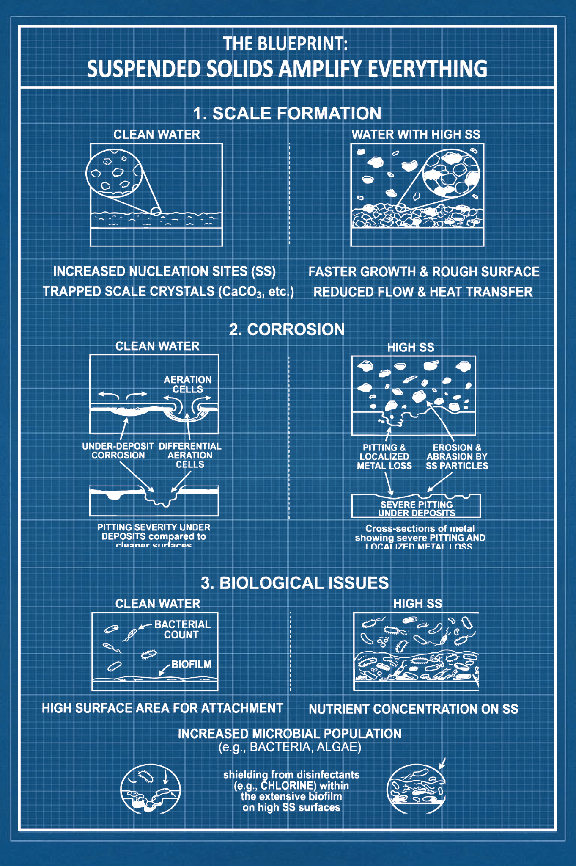
Suspended solids do not create any of these problems independently. But they amplify corrosion, scale, and microbiology simultaneously, and they do so through a single mechanism: the creation of deposits that change the local environment and steal access.
Deposits and Corrosion
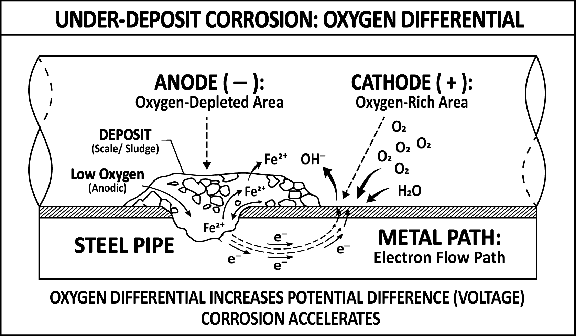
When particles settle on a metal surface, they create a physical barrier between the metal and the bulk water flowing past it.
In the Corrosion chapter, we explored the oxygen differential cell - the mechanism by which areas of low oxygen concentration become anodic, while areas of high oxygen concentration become cathodic. Deposits create exactly this condition. Beneath the deposit, oxygen is consumed by the metal but cannot be replenished. The covered area becomes starved. The chemistry under the deposit diverges from the bulk water. pH commonly drops, transport becomes restricted, and aggressive ions can concentrate in the occluded zone. The area becomes a self-reinforcing corrosion pit.
This is under-deposit corrosion, and it is one of the most common failure modes in cooling tower systems.
The insidious part is that the bulk water chemistry may look perfect. Your corrosion inhibitor residual tests on target. Your pH is within range. Your conductivity is right where you want it. But beneath the deposit, the chemistry is very different. The deposit has isolated the metal from the treatment program.
The corrosion is not occurring in the water you are measuring. It is occurring beneath the solids you are ignoring.
Deposits and Biology
Suspended solids provide something biology values even more than nutrients.
Shelter.
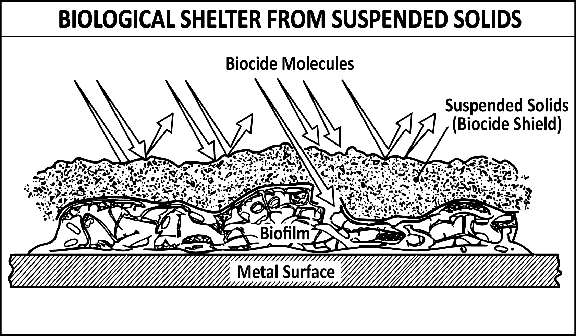
In the Microbiological chapter, we explored how biofilms create protected chemical environments. Deposits accelerate this process dramatically. A layer of silt, corrosion product, or organic debris is not just an obstacle for chemistry - it is a prefabricated home for microorganisms.
Biofilms can form on clean metal, but they form faster and persist longer on surfaces already coated with particulate matter. Deposits provide:
- physical protection from oxidizing biocides
- stagnant microzones where organisms establish
- nutrient surfaces that support early colonization
Once biology establishes beneath a deposit, the relationship becomes mutually reinforcing. The biofilm stabilizes the deposit. The deposit shields the biofilm. Biocide demand rises, but access declines.
What started as “dirt” becomes biological infrastructure.
Deposits and Scale
In the Scale chapter, we explored nucleation - the kinetic barrier that prevents supersaturated water from instantly forming crystals. We described how the first stable nucleus changes the rules, providing a template for further growth.
Deposits lower that barrier.
A particle of silt, a fragment of corrosion product, or a piece of biological debris presents a surface with irregularities, charge distributions, and energy states that differ from the bulk solution. For a dissolved ion pair that is thermodynamically ready to crystallize but kinetically limited, a deposit surface can serve as a heterogeneous nucleation site - a shortcut that bypasses the energetic penalty of forming a new solid-liquid interface from scratch.
Scale does not need deposits to form. But deposits make it easier, faster, and more likely - particularly in the localized zones of high heat flux where surface supersaturation increases.
The Compounding Effect
These pathways do not operate independently. They compound.
Deposits create oxygen differentials that drive corrosion.
Corrosion produces more suspended solids.
More solids create more deposits.
Deposits shelter biology.
Biofilms produce polymers that trap more solids.
Trapped solids provide more nucleation sites for scale.
Scale and deposits degrade heat transfer, intensifying local conditions at surfaces.
One layer of dirt becomes corrosion becomes biology becomes scale becomes failure.
This is the amplifier effect. Suspended solids are not the disease. They are the condition that lets every disease take hold.
| CONCEPT LOCK Deposits create oxygen differentials that drive under-deposit corrosion. Deposits shelter biology from biocides and accelerate biofilm formation. Deposits provide heterogeneous nucleation sites that lower the kinetic barrier to scale. These effects compound: solids → deposits → corrosion → more solids → biology → scale. |
|---|
Controlling the Amplifier
Suspended solids are a mechanical problem. They cannot be solved with chemistry alone.
Once particles enter a system, the only permanent solution is physical removal. Chemistry can support removal - dispersants can prevent agglomeration and help lift solids off surfaces - but it cannot substitute for removing the particles from the water entirely.
The strategy is attrition, not elimination.
Particles do not need to be captured in a single pass. They need to be removed faster than they accumulate. Over time, even modest removal rates produce dramatic improvements in surface cleanliness, biocide effectiveness, and heat-transfer performance.
Sidestream Filtration: The Workhorse
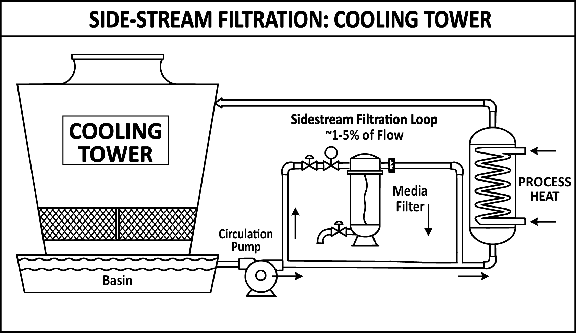
In open recirculating systems, sidestream filtration is the most reliable tool available.
A small fraction of the circulating water - typically 1–5% of the recirculation rate - is continuously diverted through a filter and returned to the basin. Sand filters, multimedia beds, disk filters, and automatic screen filters are all used depending on the particle size distribution and the solids loading.
The key principle is cumulative removal. A sidestream filter processing 5% of the recirculating flow does not clean the entire system in one pass. But over hours and days, the total volume processed can exceed the system volume many times.
Sidestream filtration rarely solves a visible problem overnight. It prevents invisible problems from becoming visible.
The general sizing guideline is to turn over the system volume (basin + piping + exchangers) through filtration at least once every 4 hours, then adjust based on loading. High dust, heavy construction, chronic basin sediment, degraded fill, or critical reliability often justify 2–4 hour turnover targets.
Settling and Basin Design
Gravity is always working.
In cooling tower basins, heavy particles - sand, grit, rust - settle naturally when flow velocity drops below their settling velocity. Basin design plays a significant role: deep sumps, sloped floors, and properly located suction points can keep settled solids away from pump intakes, where they would otherwise be redistributed.
Light particles - biological debris, fine silt, organic fragments - do not settle readily. They remain suspended at typical cooling flow conditions and require mechanical filtration to remove.
Understanding the particle size and density distribution in your system tells you which removal mechanism will work and which will not. A hydrocyclone separator will remove dense grit effectively but will do nothing for fine silt. A sand filter will capture silt but will blind quickly if the loading is dominated by heavy debris that should have been settled first.
Matching the tool to the particle is the difference between effective control and wasted equipment.
Dispersants: Chemistry as Support
Dispersants are polymer-based chemistries that reduce particle adhesion and agglomeration. They adsorb onto particle surfaces and create charge or steric repulsion that keeps particles small and mobile.
Dispersants do not remove solids.
They make removal possible.
Without dispersion, particles clump into larger aggregates that settle faster, deposit more stubbornly, and resist filtration. With dispersion, the same particles remain available for capture.
Dispersants can also assist cleaning by destabilizing existing deposits and lifting settled material back into suspension. This exposes surfaces that were hidden from inhibitors and biocides.
A temporary turbidity spike after increasing dispersant is often a sign of success: you are converting deposits into removable particles.
When Systems Are Clean
The difference between a clean system and a dirty one is not cosmetic. It is functional.
In a clean system:
- corrosion inhibitors reach metal surfaces unobstructed,
- biocides contact targets with less interference,
- scale inhibitors act on dissolved ions rather than being consumed by particulate surfaces,
- heat-transfer surfaces operate near design efficiency.
In a dirty system:
- chemistry is consumed by the wrong targets, surfaces are shielded, and every failure mode accelerates. Nothing works reliably.
Good chemistry works best in a clean system.
This is not a slogan. It is a physical reality. Remove the amplifier, and treatment operates within its design window. Leave it in place, and chemistry fights uphill.
| CONCEPT LOCK Suspended solids are a mechanical problem requiring physical removal. Sidestream filtration is the primary tool: cumulative removal over time. Dispersants support removal and restore biocide access - but cannot substitute for filtration. System cleanliness determines whether chemistry can do its job. |
|---|
The Takeaway
Suspended solids do not headline failures.
They enable them.
They create deposits that steal access to surfaces, producing:
- Occluded chemistry that drives localized corrosion
- Shelter that accelerates biofilms and increases biocide demand
- Nucleation sites that lower the barrier to scale
They are the quiet amplifiers of failure.
Control solids, and corrosion inhibitors work better.
Control solids, and biocides reach their targets.
Control solids, and heat-transfer surfaces recover.
Control solids, and the program operates within the window it was designed for.
Ignore solids, and chemistry fights behind a wall.
Suspended solids are not glamorous.
They are boring things that amplify everything else that deserves your attention.
⟵ 10 Suspended Solids · Contents · 10 Suspended Solids (Engineering Notes) ⟶