⟵ 01 Building Blocks (Narrative) · Contents · 01 Building Blocks (Problem Set) ⟶
Building Blocks: Engineering Notes
“If you are reading this straight through, you can skip this section and lose nothing essential to the story. These notes are for the operators, engineers, and technicians who need to do the math.”
Why This Matters in the Field
In industrial water treatment, calculation errors usually aren’t subtle - they’re order-of-magnitude errors. This section builds three habits that prevent them:
- Reading the periodic table for behavior, not trivia
- Converting between mass ⇄ moles ⇄ particles reliably
- Using dimensional analysis to prevent unit-driven overdoses
Core Tools & Constants
| Constant | Value |
|---|---|
| Avogadro’s Number | 6.022 × 10²³ particles/mol |
| Water Molar Mass | 18.015 g/mol |
| Density of Water (room temp) | ≈ 1.00 g/mL |
| Water Density (field rule) | 8.34 lb/gal |
| 1 fl oz | 29.5735 mL |
| 1 gal | 3,785 mL |
| 1 lb | 453.6 g |
Core translator: Atomic mass (u) ↔ Molar mass (g/mol) (numerically equivalent)
Using the Periodic Table as a Tool
What the periodic table tells you
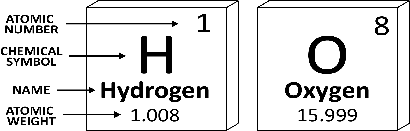
Each element box gives:
- Name
- Chemical Symbol
- Atomic Number: Defines the element’s identity (number of protons)
- Atomic Weight: Tells you how heavy a single atom is (weighted average)
Everything else - bonding behavior, ion charge, reactivity - flows from electron arrangement, especially valence electrons.
How the Table is Organized
Periods (Rows)
Each row represents the filling of a new electron shell. As you move left to right across a period:
- Atomic number increases
- Electrons are added to the same outer shell
- Chemical behavior changes gradually and predictably
- Noble Gases on the far right have full electron shells and are chemically inert
Groups (Columns)
Columns group elements with similar valence electron configurations. Because chemistry is driven by valence electrons, elements in the same column behave similarly:
- They often form ions with the same charge
- They participate in similar bonding patterns
- They exhibit similar solubility behavior in water
Valence Electrons: A Practical Rule of Thumb
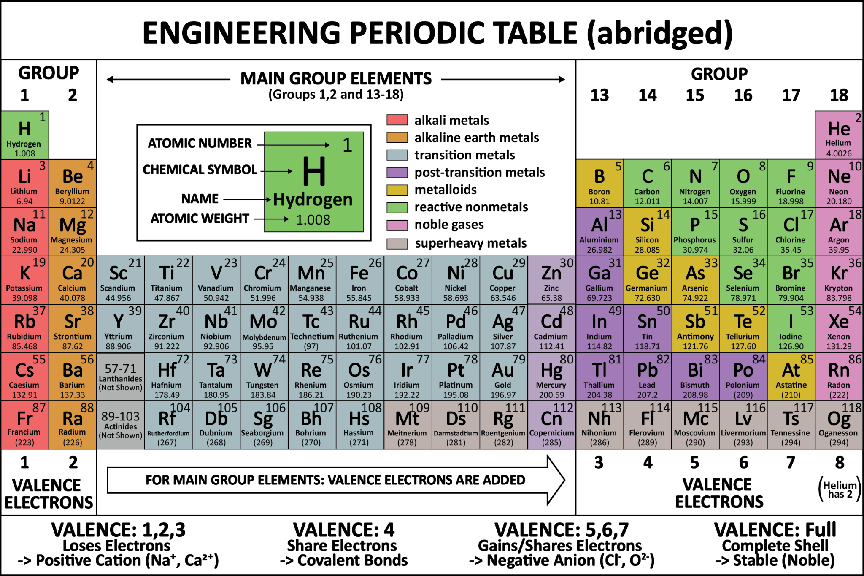
For the main-group elements most relevant to water chemistry, you can generally predict the behavior by counting columns:
| Valence Electrons | Tendency | Resulting Ion | Examples |
|---|---|---|---|
| 1, 2, or 3 | Lose electrons | Positive (Cation) | Sodium (Na+), Calcium (Ca2+) |
| 4 | Often share electrons | Covalent Bonds | Carbon (C) |
| 5, 6, or 7 | Gain or Share | Negative (Anion) | Chlorine (Cl−), Oxygen (O2−) |
| 8 | Do nothing | Stable | Helium, Neon |
Atomic Mass and Atomic Weight
Atomic mass is the summation of an atom’s constituent particles. Nearly all of that mass resides in the nucleus. Electrons contribute almost nothing by comparison - about 1/1,836 the mass of a proton.
For practical purposes:
Atomic Mass Units (u) = Number of Protons + Number of Neutrons
Atomic mass is measured in atomic mass units (u).
Just as the gram was proposed as the mass of one cubic centimeter of water, and the pound as some weird number of cereal grains, the atomic mass unit (u) required a reference point. Scientists chose the isotope Carbon-12 as the basis. A Carbon-12 atom contains:
- 6 protons
- 6 neutrons
- 6 electrons (negligible contribution)
Therefore, its atomic mass is exactly 12 u.
All other atomic masses are measured relative to this standard. Hydrogen, with just one proton, has an atomic mass of 1 u.
Atomic mass is the mass of a single atom.
Atomic weight is the weighted average of all naturally occurring isotopes of an element, accounting for their relative abundance on Earth. Because most elements exist as a stable mixture of isotopes in predictable proportions, atomic weight is effectively a fixed constant for practical purposes.
In field calculations – molar mass, dosage, stoichiometry – the difference between the two is negligible. Oxygen’s atomic weight is 15.999 rather than exactly 16, but no water treatment calculation turns on that distinction.
This book uses the terms interchangeably, as does most of the technical literature you will encounter in practice. When precision matters at the isotopic level, you will know you are in a different discipline entirely.
The Mole: Bridging Two Worlds
Knowing the mass of a single atom is interesting - but not very useful on its own. We don’t work with individual atoms. We work with grams, liters, and gallons.
To bridge this gap, chemistry relies on a translator: the mole.
Avogadro’s Number
A mole is simply a specific quantity of particles, originally determined by the number of atoms in exactly 12 grams of Carbon-12.
It is defined by Avogadro’s Number:
1 mole = 6.022 × 10²³ elementary entities
This constant connects the microscopic and macroscopic worlds. It allows us to translate:
Mass ⇄ Moles ⇄ Particles
Where particles can refer to atoms, molecules or ions.
It also determines an important relation: An element’s atomic mass (u) is equal to its molar mass (grams/mole).
- 1 mole of hydrogen weighs ≈ 1 gram
- 1 mole of oxygen weighs ≈ 15.999 grams
Different masses - but the same number of atoms in each case.
A Simple Reaction: Why Moles Matter
Chemical reactions happen between atoms, not grams. And the macroscopic world of grams, pounds, liters, and gallons is inconsistent. The same mass of different elements contain vastly different numbers of atoms.
Consider this simplified example: sodium reacting with chlorine to form sodium chloride.
Note: In the real world, elemental chlorine normally exists as Cl₂ gas, not as isolated chlorine atoms. The balanced reaction is: 2Na + Cl₂ → 2NaCl
For this calculation, we are going to count chlorine one atom at a time. That lets us focus on the main point: atoms react in fixed numerical ratios, while grams do not.
Step 1: Calculate Moles of Chlorine in 5 grams
Atomic mass (Cl) = 35.45 u → Molar mass (Cl) = 35.45 grams/mol
5 grams ÷ 35.45 grams/mole = 0.141 moles of chlorine
Note: 0.141 moles of chlorine × 6.022 × 1023 = 8.49 × 10²² chlorine atoms
Step 2: Calculate Required Sodium
Sodium reacts with chlorine in a 1:1 atomic ratio to form sodium chloride. One sodium atom pairs with one chlorine atom to form one formula unit of NaCl.
So, if we have 0.141 moles of chlorine atoms, we need exactly 0.141 moles of sodium atoms.
Equal moles means equal numbers of atoms.
Step 3: Convert Required Sodium from Moles to Grams
Atomic mass (Na) = 22.99 u → Molar mass (Na) = 22.99 g/mol
0.141 moles × 22.99 grams/mole = 3.24 grams of sodium
Even though they react one-to-one, we need less mass of sodium because chlorine atoms are heavier than sodium atoms. Therefore, the same mass (in grams) of sodium will contain more atoms.
Step 4: What if We Added 5 Grams of Sodium?
Atomic mass (Na) = 22.99 u → Molar mass = 22.99 g/mol
5 grams ÷ 22.99 grams/mole = 0.217 moles of sodium
0.217 moles of sodium × 6.022 × 1023 = 1.31 × 10²³ sodium atoms
If we added the reactants based on grams, we’d have 1.54x more sodium atoms available. By adding only 3.24 grams of sodium, we’ve achieved a perfect stoichiometric reaction and produced 0.141 moles of NaCl as the product.
Step 5: How Much Table Salt Did We Make?
Molecular mass (NaCl) = 22.99 u + 35.45 u = 58.44 u = 58.44 grams/mole
0.141 moles × 58.44 grams/mole = 8.24 grams of sodium chloride
The total mass of the reactants (5 grams of chlorine + 3.24 grams of sodium) equals the mass of the product (8.24 grams of sodium chloride). Our math maintains the “Law of Conservation of Math” (phew).
Dimensional Analysis
If I could instill one habit in every water treater, it would be dimensional analysis. It is nothing more than disciplined unit conversion, but skipping it is how people end up ten-times overdosing a system.
It takes a minute and a piece of paper, but it will save your butt.
Here’s how it works.
The Goal: Calculate the number of molecules and hydrogen bonds in an 8-ounce glass of water.
Step 1 - Fluid Ounces → Milliliters
Use the conversion factor : 1 fl ounce= 29.5735 mL.
8 fl ounces × 29.5735 mL1 fl ounces = 236.588 mL
Note how the starting unit (fl ounces) cancels with the denominator (fl ounces). Conversion factors can be flipped to make sure they cancel, and this lets you check.
Step 2 - Milliliters → grams
At room temperature, the density of water is effectively 1.00 g/mL
236.588 mL × 1.00 g1 mL = 236.588 g
The mL cancel out and we’re left with mass, which means we can enter the chemical world.
Step 3 - Grams of water → Moles of water
First, determine the Molar Mass of water (H2O):
Hydrogen = 1.008 u → 1.008 g/mol
Oxygen = 15.999 u → 15.999 g/mol
[2 × (1.008 g/mol)] + [1 × (15.999 g/mol)] = 18.015 g/mol
Now divide the grams of water by its molar mass:
236.588 g18.015 g1 mol = 236.588 g × 1 mol18.015 g = 13.13 mol
Again, this is why dimensional analysis is so critical, to make sure you’re ending up in the correct units. Dividing by g/mol cancels out the grams and moves mol to the top (the numerator). This is the same as multiplying by the mol/g. They are different methods of ensuring that units cancel.
Step 4 - Moles of Water → Molecules of Water
Plug in Avogadro’s Number, to convert our world into atoms:
13.13 mol × 6.022 × 1023 molecules1 mol = 7.91 × 1024 molecules of H2O
That is roughly 8 septillion molecules in a single glass. It’s pretty cool to be able to derive that, and even cooler to check your work with dimensional analysis. Skipping this simple process of checking units is how you end up very confident, but very wrong.
Step 5 - The Hydrogen Bonds in a Single Glass
In liquid water, the number of hydrogen bonds per molecule is not a fixed number, as bonds are constantly breaking and reforming. A water molecule can form a maximum of four hydrogen bonds. On average, a water molecule in liquid water at room temperature forms approximately 3.4 hydrogen bonds.
The total number of hydrogen bonds (NHB) is the number of water molecules multiplied by the average number of hydrogen bonds per molecule. When counting the total bonds between the molecules, we must divide by two to avoid double-counting each bond (as each bond is shared between two molecules):
Let N = molecules, b = average hydrogen bonds per molecule.
Total Number of Hydrogen Bonds:
NHB = N × b ÷ 2
Using N = 7.91 × 1024 molecules, and b = 3.4 bonds/molecule:
NHB ≈ (7.91 × 1024) × (3.4) ÷ 2 = 1.34 × 1025 Hydrogen Bonds
This is an extraordinarily huge number, representing the average hydrogen bonds at a given moment, for water at room temperature. As the temperature rises, the number of bonds decreases as molecular motion shakes them apart. As we approach the freezing point of water, the number of bonds approaches 4, with each molecule locked in a rigid tetrahedral framework.
The resulting Hydrogen-Bond Network is a remarkable display of chemical interaction that enables the endlessly fascinating properties of water.
⟵ 01 Building Blocks (Narrative) · Contents · 01 Building Blocks (Problem Set) ⟶