⟵ 05 Carbonated Water · Contents · 05 Carbonated Water (Engineering Notes) ⟶
Carbonated Water: Narrative
Carbonate Equilibrium
Carbonate chemistry is one of the most elegant negotiations in nature.
It unfolds between arguably the two most consequential molecules on earth: water and carbon dioxide. Wherever these molecules meet – which is almost everywhere – the impact of their encounter is truly profound.
Carbonate equilibrium regulates the pH of blood inside our bodies.
It shapes the chemistry of oceans, rivers, and groundwaters.
It governs buffering, scale formation, acid demand, and condensate corrosion in industrial water systems.
At first glance, carbonate chemistry looks intimidating: a web of reactions, multiple species, arrows pointing in both directions, all somehow tied to pH. It is often presented as something to memorize rather than something to understand. But the equilibrium is constantly evolving, and we must learn to predict its next move.
It is not a nuisance reaction that occasionally causes scale. It is the dominant buffer system in natural waters - the mechanism that resists abrupt pH change and determines how long chemical disturbances persist.
In the last chapter, we saw that pH decides which reactions are allowed to occur. In this chapter, we will see that carbonate equilibrium decides how long those reactions last.
Together, pH and carbonate do not merely influence water chemistry.
They govern it.
The Weight of Carbonate
There are moments in water treatment when chemistry stops being abstract and becomes painfully physical - when equilibrium shows up in mass.
One of those moments taught me this chapter the hard way.
The system was simple: a moderately sized evaporative condenser. Water was pumped from the basin to the top of the unit, sprayed across evaporator coils, then distributed across plastic fill designed to maximize air–water contact before cascading back down into the basin.
Elegant. Efficient. Minimal moving parts.
The fill itself was the key. Hundreds of angular plastic sheets stacked tightly together, engineered to expose as much surface area as possible to air. In total, roughly 60,000 square feet of wetted surface - about the size of a football field.
That surface area would soon become a liability.
As we saw in the previous chapter, pH determines which reactions in water are allowed to occur. The carbonate equilibrium lives behind those gates. This can be used to our advantage by feeding acid to inhibit the formation of calcium carbonate (CaCO3). When the pH is kept low enough, carbonate (CO32-) is suppressed and the scaling risk dissipates. But if the pH drifts upwards, carbonate is unleashed and the scaling risk amplifies.
This cooling tower relied on sulfuric acid to hold that line. It worked marvelously.
And then the acid feed failed.
The primary pH sensor failed silently, and the customer had declined my suggestion for a redundant pH probe. Acid stopped feeding. I hadn’t visited the sites in weeks and had no idea there was a problem until I got a call from a very angry facility manager.
When they said, “THE ENTIRE COOLING TOWER IS SCALED,” I assumed they were being dramatic.
They were not.
Nearly every square inch of the plastic fill was coated with calcium carbonate. A uniform, stubborn layer of whitish scale was embedded deep between sheets of fill where no brush or spray-wand could reach.
The weight was staggering. Thousands of pounds of scale clinging to the inside of the cooling tower. The gravity of the situation was clear.
pH had moved a mountain of carbonate**.**
Over the next weekend, I vacuumed and shoveled close to 2,000 pounds of scale out of that tower by hand. It was the most menial labor I’ve ever done - and the most effective chemistry lesson I’ve ever received.
Carbonate chemistry provides its own fuel. It’s present in our makeup water, and it’s transformed by the environment within our systems.
Carbonate Does Not Arrive. It Evolves.
Most ions in water have obvious origins. Calcium dissolves from rock. Sodium dissolves from salt. Hydrogen arrives with acids.
Carbonate is different.
It does not come from a single ingredient.
It emerges from equilibrium.
Carbonate enters water from two directions at once:
-
From rock - carbonate minerals weather into natural waters, usually contributing calcium, magnesium, and bicarbonate alkalinity.
-
From air - carbon dioxide dissolves into water as a gas and reacts, becoming carbonic acid, then bicarbonate, then carbonate.
These two sources converge into a single chemical system: the carbonate equilibrium:
CO₂(g) ⇌ CO₂(aq) ⇌ H₂CO₃ ⇌ HCO₃⁻ + H⁺ ⇌ CO₃²⁻ + 2H⁺
There is no true “starting point” for a chemical equilibrium. It is a chain of reversible reactions that proceeds in either direction, dictated by the contributions of bicarbonate (from rocks) and carbon dioxide (from air). We will choose to begin at the left side of the equation, where carbon dioxide dissolves from the air.
Carbonation: The First Move
From the vantage point of carbon dioxide in the air, the first move begins with physical equilibrium.
Any amount of carbon dioxide in the air surrounding water will push some into solution (this is Henry’s Law, from Chapter 3):
CO₂(g) ⇌ CO₂(aq)
Once dissolved, CO2 does not just float around. It reacts.
CO₂ is a nonpolar molecule, but its individual bonds are highly polar. This makes the carbon atom a prime target for the lone pair of electrons at one end of the oxygen atom in H2O. The result is a chemical reaction, and the first step in the chemical equilibrium that governs carbonate alkalinity.
Dissolved carbon dioxide reacts with water to form carbonic acid. Only a very small fraction of CO2 participates in this reaction, but it is enough to drive everything that follows:
CO₂(aq) + H2O ⇌ H₂CO₃
Carbonic acid can donate hydrogen to form bicarbonate:
H₂CO₃ ⇌ H⁺ + HCO₃⁻
Bicarbonate can donate hydrogen again to form carbonate:
HCO₃⁻ ⇌ H⁺ + CO₃²⁻
Together, these reversible reactions form the carbonate equilibrium:
CO₂(g) ⇌ CO₂(aq) ⇌ H₂CO₃ ⇌ HCO₃⁻ + H⁺ ⇌ CO₃²⁻ + 2H⁺
The Four Levers
The equations above walk through the equilibrium reactions from the left side of the equation. This can make each step appear like rungs in a ladder, but it’s important to understand that each step is actually a negotiation.
The same carbon atom can exist in several forms, and the position of the equilibrium depends on the overall conditions of the system.
There are four primary levers that govern the relative position: concentration, pH, temperature, and pressure.
Concentration
Carbonate speciation is the distribution of dissolved inorganic carbon into different chemical forms: CO₂, H₂CO₃, HCO₃⁻, CO₃²⁻. The contribution of carbonic acid (H₂CO₃) is generally ignored or combined with dissolved carbon dioxide because it is highly unstable and exists in extremely low relative concentrations. It will be treated as CO₂/H₂CO₃ going forward.
The relative concentration of carbonate species in solution places pressure on the equilibrium. Unlike pH, the carbonate equilibrium is a multi-faceted see-saw, and changes in concentration create impacts across the line. Add more bicarbonate (HCO₃⁻) and the equilibrium redistributes some of that increase in both directions – toward CO₂/H₂CO₃ on one end and toward (CO32-) on the other.
The concentration of each species matters tremendously, but they are typically not the most important levers. pH is usually the most useful and dominant practical predictor of carbonate speciation.
pH
As the equation suggests, hydrogen plays an important role in the equilibrium balance. H+ ions are generated as carbonic acid dissociates into bicarbonate, and again as bicarbonate dissociates into carbonate. As this is an equilibrium equation, it means that the reverse is also true: hydrogen ions are required reactants to push the equation back in the other direction. This makes hydrogen, and hydroxide by extension, fundamental determinants of the equilibrium position.
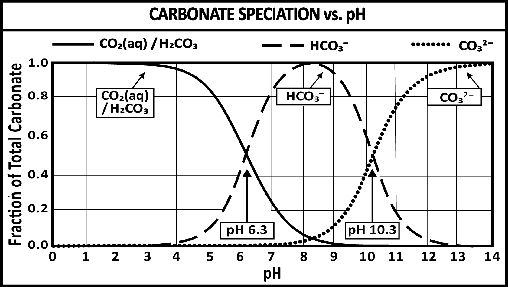
At low pH, hydrogen is abundant. This shifts the equation towards the left because hydrogen is an available reactant. This means that the concentrations of carbonate species are skewed towards carbon dioxide (CO₂/H₂CO₃).
At intermediate pH, hydrogen is no longer abundant enough to force the system strongly to the left, but hydroxide is not yet dominant enough to pull it overwhelmingly to the right. This places the carbonate equilibrium near the middle, where bicarbonate (HCO₃⁻) is the dominant species. Bicarbonate carries an unusual power: it can accept added hydrogen and become carbon dioxide/carbonic acid, or donate hydrogen and become carbonate. This is the defining trait of an effective buffer.
At higher pH, hydrogen becomes scarce and hydroxide becomes more influential. This pulls the equilibrium toward carbonate. Above about pH 8.3, carbonate becomes operationally relevant for scale formation; above about pH 10.3, carbonate becomes the dominant species.
This is why pH matters so much – it decides which carbonate species are allowed to exist. As calcium carbonate is the primary concern for many industrial water systems, this means we must stay vigilant about the tipping point between species.
A general view of carbonate forms can be summarized as:
- Below about pH 6.3: dissolved CO₂/H₂CO₃ predominates
- Roughly pH 6.3 to 10.3: bicarbonate predominates
- Above about 8.3: carbonate becomes operationally relevant
- Above about pH 10.3: carbonate predominates
The same atoms are always present, but their arrangement changes based on pH.
Temperature
Heat is the lever that turns a stable water into a scaling one.
Three things happen at once as temperature climbs, and they all push the same direction.
First, CO₂ becomes less willing to stay dissolved. Gas solubility falls as water warms, so dissolved CO₂ escapes. The equilibrium chases what it lost – pulling back toward CO₂/H₂CO₃, consuming hydrogen ions as it goes – and the pH climbs.
Second, the dissociation constants shift. Warmer water more readily strips hydrogen from carbonic acid and from bicarbonate, nudging the system toward carbonate.
Third, carbonate stops staying in solution. Calcium carbonate exhibits inverse solubility – it precipitates more as things get hotter, not less.
Stack those together and you have the recipe for scale.
This was part of the problem that pushed my cooling tower over the edge, depositing a football field worth of scale on the fill. Rising pH, bicarbonate tipping toward carbonate, and calcium carbonate falling out of solution exactly where the water is warmest.
This is why the hottest surface in a system is almost always the first to scale – and why boilers cannot tolerate hardness intrusion.
---
Pressure
Pressure works the lever from the opposite end – and its consequences leave the system entirely.
In the open air, higher CO₂ pressure drives more gas into solution (Henry’s Law again). More dissolved CO₂ pushes the equilibrium toward the acid side, lowering pH and keeping carbonate scarce.
Inside a boiler, pressure compounds what heat already started. The thermal breakdown of bicarbonate throws off carbon dioxide; higher pressure pushes that breakdown further, converting carbonate to hydroxide and releasing still more CO₂. And none of it stays put. It rides out with the steam, travels the length of the system, and re-dissolves in the condensate as carbonic acid – turning yesterday’s harmless feedwater alkalinity into tomorrow’s corrosion, a pipe-length away from where it started.
| CONCEPT LOCK Carbonate does not arrive in water. It evolves through equilibrium. pH determines which species dominate: CO₂, bicarbonate, or carbonate. The same atoms rearrange into different species depending on conditions. |
|---|
Gas Meets Rock: Natural Water Stability
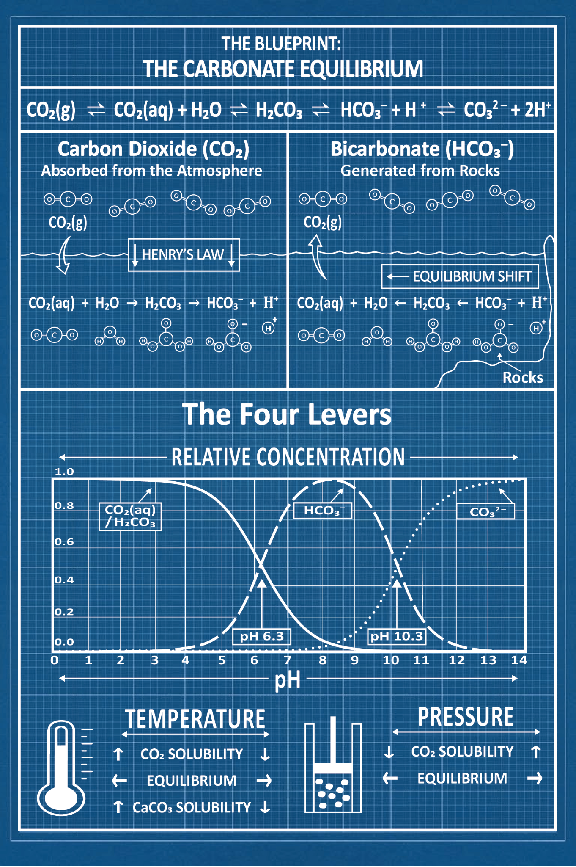
In rivers, lakes, and groundwater, the carbonate system behaves beautifully.
Carbon dioxide enters from the atmosphere.
Bicarbonate and carbonate enter from dissolved rocks.
The result is a natural buffering system that tends to settle into a relatively consistent pH range, usually somewhere around 6 to 8.
This is not a coincidence.
Bicarbonate sits in the middle of the carbonate system. It can absorb hydrogen and become carbonic acid, or donate hydrogen and become carbonate. That dual role allows it to resist sudden pH change in either direction.
When acid enters the water, bicarbonate absorbs part of the disturbance.
When base enters the water, bicarbonate helps absorb that too.
CO₂(g) ⇌ CO₂(aq) ⇌ H₂CO₃ ⇌ HCO₃⁻ + H⁺ ⇌ CO₃²⁻ + 2H⁺
That is why most natural waters are not chemically fragile. The carbonate system softens ordinary disturbances before they can become dramatic swings in pH.
Bicarbonate is the buffer.
It is the quiet stabilizer of natural water.
| CONCEPT LOCK Bicarbonate is the buffer. It can absorb added hydrogen or donate hydrogen when a base pushes the system the other way. This dual role holds pH in a narrow, stable range - until the system overwhelms it. |
|---|
Why Cooling Towers Break the Balance
Cooling towers do something natural systems do not.
They continuously strip carbon dioxide from water.
Every pass across the fill creates ideal conditions for CO₂ removal:
- Warm return water - accelerates molecular motion
- Massive Air Flow - creates a large gas-liquid interface
- Enormous Surface Area - breaks water into thin films and droplets
Every step encourages dissolved carbon dioxide to leave.
As CO₂ escapes, the equilibrium shifts to replace it. Carbonic acid decomposes to replace the dissolved gas. Bicarbonate joins with hydrogen to replace the carbonic acid. The concentration of hydrogen in the water falls, and the system expresses that loss as rising pH.
CO₂(g) ← CO₂(aq) ← H₂CO₃ ← HCO₃⁻ + H⁺
Nothing was dosed.
Nothing failed chemically.
The system simply obeyed equilibrium.
As pH rises past roughly 8.3, carbonate is no longer strongly suppressed. Once carbonate is allowed to exist, calcium carbonate becomes thermodynamically favorable. Given sufficient alkalinity and calcium already present in the tower, scale forms relentlessly - across a football field of surface area.
pH is not the cause of scale.
But it gives carbonate permission.
Where Alkalinity Goes in Boilers
Cooling towers drive carbonate trouble by stripping CO₂ from open water. Boilers cause a similar problem in a different way.
Boilers are closed systems. They are not exposed to atmospheric exchange the way cooling towers are. Instead, carbonate chemistry enters with the makeup water, primarily as bicarbonate alkalinity.
Once inside the boiler, a new lever takes over: Heat.
As temperature rises, bicarbonate becomes unstable. Thermal energy pushes bicarbonate to form carbonate, water, and carbon dioxide:
2HCO₃⁻ ⇌ CO₃²⁻ + H₂O + CO₂↑
The resulting carbon dioxide cannot remain dissolved under boiler conditions. It volatilizes with steam and is carried into the header.
The resulting carbonate means that any calcium present will precipitate – and because of inverse solubility, it will do so directly on heat-transfer surfaces. This is why boiler makeup must be effectively softened. Even trace calcium will plate out where heat transfer matters most.
At higher boiler pressures and temperatures, carbonate alkalinity can break down further through hydrolysis, producing hydroxide and additional carbon dioxide:
CO₃²⁻ + H₂O ⇌ 2OH⁻ + CO₂↑
As boiler pressure and temperature increase, more alkalinity can be converted into carbon dioxide that leaves with the steam, increasing the potential for condensate corrosion downstream.
As steam cools and condenses, the carbon dioxide dissolves back into the condensate and reforms carbonic acid:
CO₂(g) ⇌ CO₂(aq) ⇌ H₂CO₃ ⇌ HCO₃⁻ + H⁺
The buffer system has effectively been broken apart. Very little buffering capacity remains. In untreated condensate systems, the pH can fall sharply and become severely corrosive. Steel is aggressively attacked. Channels form along the bottom of the pipe.
Carbonate chemistry has come full circle.
How We Interrupt the Cycle
In cooling towers, acid is used to suppress carbonate formation.
In boilers, there are two strategies:
Neutralize Alkalinity Upstream
Reverse osmosis and dealkalizers can be used to remove bicarbonate before it enters the boiler. With alkalinity removed, alkalinity-derived carbon dioxide is greatly reduced, and the condensate corrosion pathway is largely controlled.
Neutralize Acidity Downstream
Neutralizing amines volatilize with the steam and condense with water, raising condensate pH and neutralizing acidity before carbonic acid can attack metal.
As a rule of thumb, roughly 0.79 ppm of CO₂ is generated for every 1 ppm of M-alkalinity as CaCO₃ in the feedwater. High alkalinity means high chemical demand.
Whether through capital investment upstream or operating cost downstream, alkalinity must be controlled.
Carbonate chemistry does not disappear in boilers. And unless it is deliberately interrupted, it carries consequences far beyond the boiler itself.
Managing Carbonate
Carbonate chemistry is often ignored because it is easy to mistake it for a side reaction.
It is not.
Carbonate is the dominant buffer system in natural waters, the hidden driver behind pH stability, acid demand, cooling tower scaling, and condensate corrosion. It is not misbehaving. It is doing exactly what equilibrium demands.
The real question in water treatment is never whether carbonate chemistry will act.
It is where it will act - and how much leverage it will have when it does.
Fortunately, the equilibrium that governs it behaves predictably. If you understand carbonate chemistry, you are no longer reacting to scale, corrosion, or acid demand.
Your job as a water treatment consultant is to decide deliberately where that equilibrium is allowed to land. I learned that lesson shoveling two thousand pounds of scale out of a cooling tower – the physical weight of an equilibrium I had failed to control.
⟵ 05 Carbonated Water · Contents · 05 Carbonated Water (Engineering Notes) ⟶