⟵ 08 Scale · Contents · 08 Scale (Engineering Notes) ⟶
Scale: Narrative
Dissolved Solids
Every dissolved ion was once a highly motivated part of a solid structure.
Their motivation was purely thermodynamic.
Charged particles achieve lower energy states by binding to oppositely charged partners. They take this a step further by arranging themselves into crystalline lattices - repeating, three-dimensional structures that distribute charge across many atoms at once. In these lattices, no single bond carries the full energetic burden. Electrostatic forces are shared, stabilized, and minimized collectively.
This is why solids form so readily in the first place.
A crystal lattice is not fragile.
It is an energy minimum.
And minimizing energy left the solid structure perfectly content. At least until water got involved.
Water’s role in that process was also purely thermodynamic. It did not dissolve the solid because it “wanted to,” or because the solids were unstable. The Hydrogen-Bond Network simply enforces negotiation - one governed by energy, charge, and geometry.
In Chapter 3, we examined the thermodynamics of dissolution. The cost to dismantle the solid was determined by the lattice energy, which emerged from the electrostatic stability of the crystal lattice. It was repaid through dispersed charge and hydration.
By stabilizing separated charge, water lowered the energy of the combined water-ion system. Water did what it is designed to do.
But dissolution is not a permanent thermodynamic verdict.
Changes to the chemical environment can push dissolution back in the opposite direction by influencing the negotiation. In real water systems - cooling towers, boilers, and process loops - the balance is continuously influenced by operating conditions.
Calcium carbonate will be our primary example - not because it is unique, but because it reveals the general rules by which all scale emerges.
| CONCEPT LOCK Dissolution asks: what does it cost to pull ions apart? Scale asks: what does it cost to keep them apart? Same forces. Different direction. The balance shifts with temperature, pH, and concentration. |
|---|
A Dynamic Balance
Both temperature and pH undergo unavoidable changes in process water systems.
These systems are designed to transfer heat - which raises temperature - and they continuously shift pH through carbonate chemistry - via carbon dioxide stripping in cooling towers and bicarbonate decomposition in boilers. Each of these changes significantly alters the chemical environment and biases the thermodynamic negotiation between hydration and lattice formation.
Temperature
Temperature influences this balance by changing the relative stability of the dissolved state and the solid state.
For many salts, increasing temperature makes the dissolved state more favorable. The added thermal energy helps offset the energetic cost of separating ions from the lattice, so solubility rises.
Calcium carbonate behaves differently. As temperature rises, the hydrated, dispersed state becomes less competitive. Hydration depends on ordered water around separated ions, and that ordering becomes harder to maintain as thermal motion disrupts the Hydrogen-Bond Network. At the same time, carbon dioxide becomes less soluble, which shifts carbonate chemistry toward conditions that favor calcium carbonate formation.
The lattice does not need to become stronger. The dissolved state only needs to become less favorable.
This behavior is known as inverse solubility, and it explains why calcium carbonate scale forms most aggressively exactly where temperature is highest: at heat-exchange surfaces.
pH
pH influences the balance in a different way.
Temperature changes the competitiveness of hydration. pH changes the identity of the species being hydrated.
Carbonate chemistry is the most important example. At lower pH, carbonate is suppressed. Hydrogen ions convert carbonate into bicarbonate and carbonic acid, species that remain far more willing to stay dissolved with calcium present. Under those conditions, calcium carbonate formation is limited because carbonate ion is not available in meaningful concentration.
As pH rises, hydrogen ion concentration falls, and carbonate becomes increasingly favored over bicarbonate and carbonic acid. Calcium now has access to CO₃²⁻, a doubly charged ion that forms a low-solubility solid with a strong thermodynamic drive toward crystallization.
Raising pH does not make the calcium carbonate lattice stronger. It allows the right pieces of that lattice to exist at the same time.
That is why pH is the gatekeeper for calcium carbonate scale.
Bias, Not Drive
Temperature and pH matter. They shape reaction pathways, determine which species are available, and bias the negotiation between hydration and lattice formation.
But they do not accumulate.
Temperature fluctuates. pH can be adjusted.
Concentration, by contrast, steadily increases as water is removed and dissolved ions are left behind. That is why concentration remains the dominant driver of scale formation.
In terms of Gibbs free energy, scale becomes favorable when the dispersed, hydrated state is no longer the lowest-energy arrangement available to the system. Below that point, water can still pay the energetic cost of keeping ions separated. Above it, the balance shifts. The lattice becomes the cheaper outcome.
That is when dissolved ions stop behaving like passengers.
That is when order re-emerges.
Concentration: The Cost of Disorder
Concentration is more than just a number on a service report.
It is a measure of how many dissolved ions water is being asked to keep apart at once.
At low concentrations, that job is relatively easy. Hydration shells form readily. The Hydrogen-Bond Network has room to reorganize. Collisions between compatible ions are rare, and when they occur, water can usually stabilize them as separate species at lower overall free energy than if they were locked into a crystal.
In this regime, the dissolved state is thermodynamically favored.
Many industrial water systems, however, achieve efficiency by concentrating the recirculating water. In cooling towers, this happens continuously: as water evaporates to reject heat, pure water leaves the system as vapor. The dissolved minerals do not evaporate. They remain behind. Every unit of water removed increases the concentration of every ion that stays.
The ratio of tower concentration to makeup concentration is called Cycles of Concentration. At two cycles, every ion is at twice its makeup level. At four cycles, four times. At six, six times. Blowdown - the deliberate discharge of concentrated water - is the only mechanism that relieves this pressure. The balance between evaporation and blowdown determines where the system operates.
The economic incentive is always to push cycles higher. Higher cycles mean less water consumed, fewer chemicals used, and less discharge. But higher cycles also mean more thermodynamic pressure on the dissolved state.
As concentration increases, something fundamental changes.
Water is now being asked to stabilize more charged particles in the same volume. The ions are closer together. Their activities rise. The free energy of remaining dispersed rises with them. Nothing about the ions has changed, and nothing about the crystal lattice has changed. What changes is the energetic cost of keeping those ions hydrated and separate.
At some point, the dissolved state is no longer the lower-Gibbs arrangement.
This is the core reason scale forms in industrial systems.
Not because a solid suddenly became possible, but because under the new conditions the solid has become more stable than the separated ions.
| CONCEPT LOCK Cycles of concentration multiply the chemical pressure inside a system. Evaporation removes water. Minerals remain. Every cycle brings ions closer together. The objective is not to eliminate scaling pressure, but to operate as close to its limit as safely possible. |
|---|
The Thermodynamic Tipping Point
That tipping point is described by the solubility product constant, Kₛₚ.
Kₛₚ marks the condition at which the dissolved state and the solid state balance one another thermodynamically. It is determined experimentally by finding the concentration at which dissolution and precipitation are in equilibrium on average.
Below this boundary, the dissolved state is favored.
At the boundary, the two states balance.
Above it, precipitation becomes thermodynamically favorable.
Crossing Kₛₚ does not cause scale.
It grants permission.
The system has not yet formed a deposit, but it has crossed the line where remaining dissolved is no longer the lowest-energy outcome. What happens next depends on probability, organization, and time.
Supersaturation: Permission, Not Speed
When dissolved ions exceed their solubility limit, the solution becomes supersaturated. It is now in a metastable state: precipitation is thermodynamically favored, but no stable solid has yet formed.
This distinction matters.
Gibbs free energy determines the preferred destination.
Kinetics determines how quickly the system can get there.
For bulk precipitation to begin, three conditions must be satisfied simultaneously:
- Ions must collide with complementary partners
- They must do so in an orientation consistent with a repeating lattice
- They must remain associated long enough for others to join
Until that happens, the system can remain clear even though crystallization is already favored.
Supersaturation marks the boundary between permission and action.
Permission has been granted by thermodynamics.
Action is a matter of kinetics.
Scale Indices: Estimating Thermodynamic Pressure
Kₛₚ defines the thermodynamic boundary of solubility, but it has an important limitation: it defines this boundary in terms of ion activity, not concentration. In real water systems, ion activity can diverge significantly from concentration, leading to poor estimates of solubility.
Rather than abandoning thermodynamics, the water treatment industry has taken a different approach. It relies on empirical indices to estimate how close a given water is to the conditions under which scale has historically formed.
The Langelier Saturation Index (LSI) and the Ryznar Stability Index (RSI) are the most widely used. Both estimate the thermodynamic pressure on calcium carbonate - whether water is biased toward dissolving CaCO₃ or forming it, and how strongly it is being pushed. Their application is explored in the Engineering Notes.
These indices do not replace thermodynamics.
They translate it.
It is worth noting that LSI and RSI apply only to calcium carbonate. They say nothing about calcium sulfate, silica, calcium phosphate, or any other scaling salt. The Engineering Notes catalog the specific salts that matter in water treatment and the levers that govern each.
Scale Formation
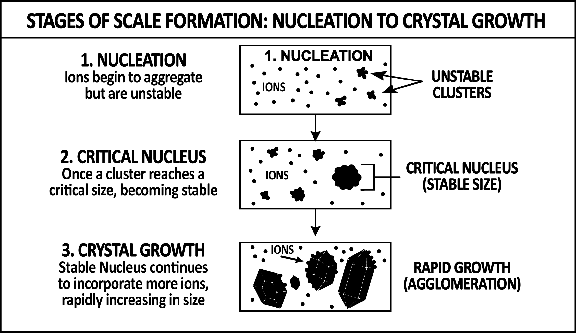
Solids begin very small.
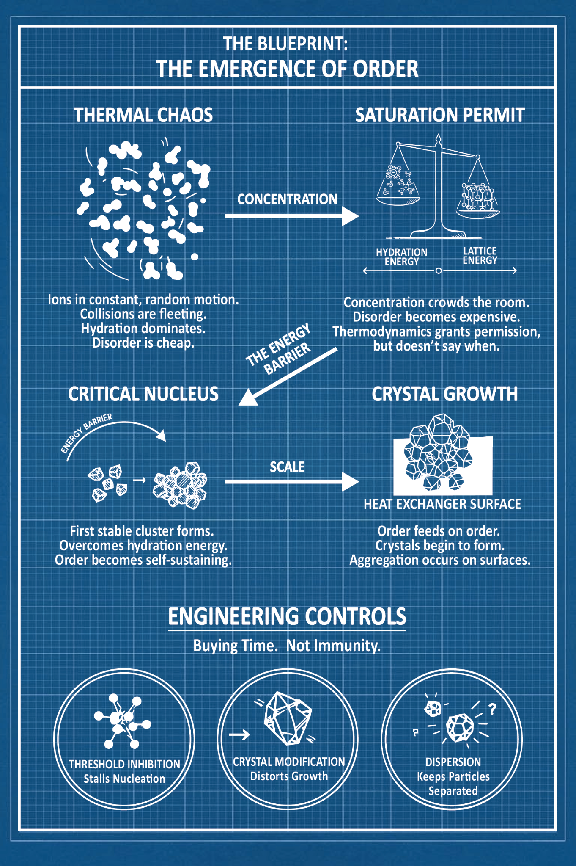
In solution, ions are in constant motion. Thermal energy drives them at astonishing speeds as they collide, separate, and re-collide billions of times per second. Most of these encounters are fleeting. Thermal motion pulls the ions apart as quickly as electrostatic attraction brings them together.
Occasionally, however, a small cluster forms that is stable enough to persist.
This is nucleation.
At first, these clusters are unstable. A few ions may momentarily associate, but the energetic cost of creating a new solid–liquid interface outweighs the stabilizing benefit of lattice formation. The cluster dissolves back into solution.
But if a cluster grows beyond a critical size, something changes.
The energetic balance flips.
Once that threshold is crossed, the cluster becomes a nucleus - a stable seed of solid order embedded in the liquid.
This is the first handshake.
Before nucleation, every ion must negotiate its stability independently with the surrounding water. After nucleation, the work is shared. The nucleus provides an ordered template - an energetically favorable surface that additional ions can attach to with far less resistance.
From this point forward, scale formation accelerates.
Crystal Growth: Why Order Feeds on Itself
As additional ions attach to the nucleus’ repeating pattern, charges become delocalized across the growing lattice.
This distribution of charge is stabilizing.
Each added ion participates in multiple electrostatic interactions simultaneously. No single bond carries the full energetic burden. Instead, the lattice behaves as a collective structure, where breaking one interaction requires disturbing many others.
With each new layer added, the system’s free energy decreases. Ions that were once stabilized individually by hydration are now stabilized collectively by the lattice.
What began as a marginally stable cluster becomes a deeply stable solid.
This is why crystal growth is self-reinforcing. The first ordered surface lowers the activation energy required for the next ion to attach. The next attachment makes the following one easier still.
Order feeds on order.
At the molecular scale, this transition is profound. What began as isolated ions negotiating with water becomes a structured solid negotiating with solution as a unit.
At the macroscopic scale, the result is familiar: hard, adherent deposits that resist removal.
Aggregation: When Small Solids Become Big Problems
The first solid matters because it changes the rules of the system.
Before nucleation, ions move independently. Their interactions are fleeting and usually reversible. After nucleation, solids exist – and solids can interact not only with each other, but with the surfaces around them.
As microscopic particles form, they collide continuously under the influence of flow, diffusion, and turbulence. In concentrated industrial waters, electrostatic repulsion is reduced, so more of those collisions lead to attachment rather than separation.
But aggregation does not happen only between particles.
Metal surfaces make this even easier. They are chemically and electrically distinct from bulk water, and they provide imperfections, oxide films, and roughness that help particles anchor. Once a particle adheres, it becomes more than a deposit. It becomes a new nucleation site.
This is why scale appears first on metal surfaces, and why it concentrates on hot, high-flux areas where hydration is already destabilized. Once surface-bound aggregation begins, growth accelerates and removal becomes difficult.
Preventing scale is therefore not just about keeping ions dissolved. It is about preventing early solids from becoming organized enough to persist–or from finding a surface willing to host them.
Scale Inhibitors
Scale inhibitors are among the foundational chemistries of the water treatment industry. They allow cooling towers to operate at higher cycles, prevent hardness excursions from shutting down boilers, and protect high-flux surfaces like heat exchangers and membranes.
Scale inhibitors do not eliminate the thermodynamic drive to form scale.
That drive is real, measurable, and persistent. Supersaturated water wants to crystallize, and no chemical program can make that desire disappear.
What inhibitors do is slow the kinetics.
They delay nucleation, distort crystal growth, and keep particles dispersed long enough for the system to remove them through blowdown or filtration. In doing so, they allow engineered systems to operate safely in conditions that would otherwise scale rapidly.
This distinction matters.
Thermodynamics sets the direction.
Kinetics sets the pace.
The degree of supersaturation and thermodynamic driving force defines how much stress inhibitors must operate under. Mild conditions may be easily managed. Strong driving forces signal rising stress, higher cost, and increasing dependence on kinetic control.
The more pressure the chemistry applies, the more work inhibitors are asked to do.
How Scale Inhibitors Work
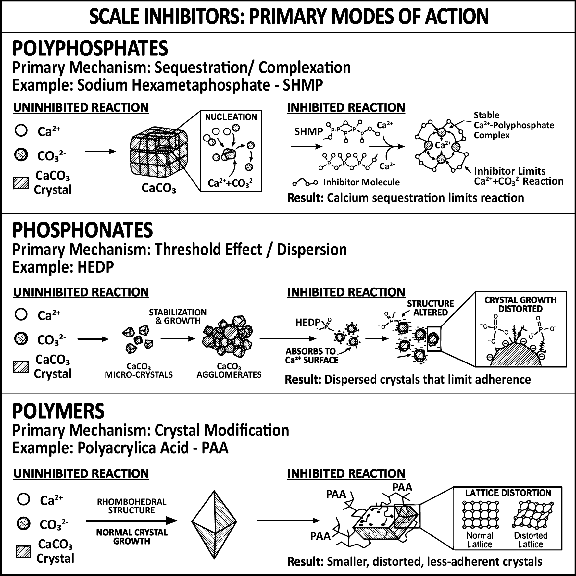
Scale inhibitors fall into three broad classes, each targeting a specific stage of crystal formation.
Polyphosphates
Polyphosphates are chains of phosphate units used primarily in potable and light industrial systems. Sodium hexametaphosphate (SHMP) is a common example.
Their primary function is sequestration and threshold inhibition. By forming soluble complexes with hardness ions, polyphosphates reduce the effective concentration of calcium available to participate in lattice formation. They also interfere with very early stages of crystal development.
Their limitations are structural. Polyphosphates are chemically fragile. In high-temperature or high-stress environments, they hydrolyze into orthophosphate, losing their sequestering ability and, in some cases, contributing directly to scale formation.
As a result, their use is generally confined to low-temperature, low-stress applications.
Phosphonates
Phosphonates are organic molecules containing phosphonate functional groups bonded to carbon. The terminology varies - phosphonates, organophosphonates, organic phosphonates - but the defining feature is the carbon–phosphorus bond, which gives these molecules far greater thermal and chemical stability than polyphosphates.
Common examples include HEDP, ATMP, and PBTC.
Phosphonates operate as threshold inhibitors. This form of scale inhibition is effective well below stoichiometric concentrations, as phosphonates adsorb onto nascent crystal nuclei and interfere with their ability to reach critical size.
Supersaturation persists.
Thermodynamic pressure remains.
But nucleation stalls.
Phosphonates do not remove calcium or carbonate from the system. They prevent those ions from organizing into a stable, repeating lattice. By selectively binding to high-energy growth sites on forming crystals, they disrupt the charge distribution required for lattice stabilization.
The result is disproportionate control: very small amounts of chemistry exerting large kinetic influence.
Polymers
Polymers are chains of repeating monomer units bearing charged functional groups. They operate through crystal modification and dispersion.
The functional groups allow polymers to adsorb onto growing crystal surfaces, distorting lattice geometry and preventing orderly growth. Crystal faces become irregular, edges malformed, and the repeating order required for strong adhesion is lost.
Aggregation is also suppressed. Instead of forming dense, adherent deposits, crystals remain small, irregular, and weakly associated. These particles stay suspended and are more easily transported out of the system.
At the molecular scale, this effect is dramatic. Well-formed, sharply faceted crystals are transformed into soft, poorly ordered particles with greatly reduced fouling potential.
Polymers do not prevent crystals from existing.
They prevent crystals from succeeding.
Buying Time, Not Immunity
None of these inhibitors defeat thermodynamics.
They do not erase supersaturation.
They do not eliminate scaling ions.
They do not repeal solubility limits.
They buy time.
They delay the moment when order becomes self-sustaining - when a stable lattice forms, growth accelerates, and scale becomes inevitable. Used intelligently, they allow systems to operate safely beyond equilibrium boundaries that would otherwise be unreachable.
This is why formulation matters.
Experienced formulators combine sequestration, threshold inhibition, and crystal modification to match specific water chemistries, temperatures, residence times, and surface conditions. As systems approach their practical limits, that expertise becomes decisive.
Scale control is not about preventing chemistry from happening.
It is about preventing structure from taking hold.
| CONCEPT LOCK Inhibitors do not change the thermodynamic verdict. They delay the kinetic outcome. Sequestration reduces the effective concentration of scaling ions. Threshold inhibition stalls nucleation well below stoichiometric doses. Crystal modification and dispersion prevent solids from organizing into adherent deposits. The more thermodynamic pressure the chemistry applies, the more work inhibitors must do. |
|---|
Managing the Inevitable
Scale is the natural consequence of ions seeking a lower-energy state. It is not a defect in water, a failure of chemistry, or a mistake in operation. It is what happens when dissolved matter is given the opportunity to organize.
Water treatment does not eliminate that drive.
It delays it.
It disrupts it.
It redirects it.
By understanding solubility and supersaturation, we learn why scale is allowed to form. By understanding temperature effects and concentration, we learn why it appears first on hot, high-flux surfaces. And by understanding nucleation and crystal growth, we learn why the first solid matters far more than the last.
This knowledge changes the problem.
Scale control is no longer about avoiding limits. It is about operating deliberately beyond them. It is about recognizing when thermodynamics grants permission - and using kinetics to decide whether that permission is acted upon.
In well-designed systems, we routinely operate in supersaturated conditions that equilibrium chemistry alone would declare impossible. We do so not by denying physics, but by respecting it - by slowing the emergence of order just long enough to move heat, reject energy, and keep industrial processes alive.
Dissolved solids never lose their motivation.
We simply give water the resources to suppress it - for a while.